Telescopes

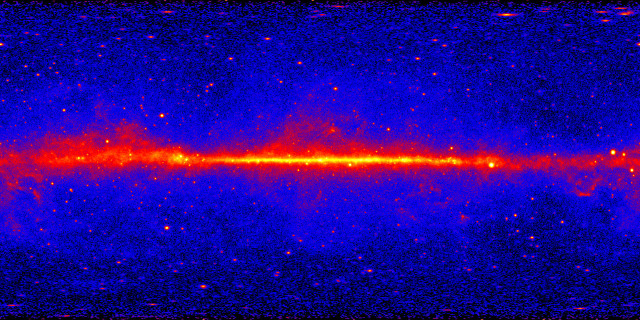
Map of high-energy Gamma Rays (Image NASA/DOE/Fermi LAT Collaboration)

An article published in the journal “Nature Astronomy” describes a research that indicates the origin in an anomalous gamma-ray source detected for the first time in 2009 by the NASA’s Fermi gamma-ray space telescope. One of the hypotheses concerned collisions of dark matter particles, instead according to a team of astronomers there are millisecond pulsars in the nucleus of the Milky Way whose emissions mixed up in the signal detected by Fermi.

Artist's concept of New Horizon's Ultuma Thule flyby (Image NASA/JHUAPL/SwRI/Steve Gribben)

NASA has announced that it chose Ultima Thule as a nickname for 2014 MU69, the Kuiper Belt Object that represents the next target for its New Horizons space probe. In recent months, the mission team asked for suggestions on the Internet and then opened a ballot allowing to select the favorite among the nicknames selected among the thousands of proposals. The result is not an official name, which must be ratified by the International Astronomical Union (IAU), because it’s not clear if Ultima Thule is a single object.

Illustration of exoplanets orbiting red dwarfs

An article published in “The Astronomical Journal” shows the confirmation of 15 exoplanets that orbit red dwarfs. A team of researchers led by Teruyuki Hirano from the Tokyo Institute of Technology used data collected by NASA’s Kepler space telescope and follow-up observations. Another article in the same journal focuses on 3 confirmed super-Earths including K2-155d, which could be in ​​its system’s habitable zone.

The Orion Nebula

An article published in the journal “Astronomy & Astrophysics” describes a new study of the Orion Nebula. A combination of observations made with the ALMA radio telescope, the 30-meter IRAM telescope and the HAWK-I instrument installed on ESO’s VLT allowed the creation of a unique image of the Orion Nebula. It’s an area of ​​space in which there are various molecular clouds where gas concentrations give life to new stars in processes that can be best studied by putting together the data collected at different electromagnetic frequencies.

Artist's concept of binary system with a red giant and a neutron star stealing its materials (Image NASA/Dana Berry)

An article accepted for publication in the journal “Astronomy & Astrophysics” describes the discovery of a binary system in which one of its two stars emitted an X-ray flare because it’s a neutron star that steals materials from its companion, a red giant. A team of researchers used observations of various telescopes to study the event indicated as IGR J17329-2731 and defined it the birth of a symbiotic X-ray binary.