Telescopes

Artist's concept of WASP-39b and its star (Image NASA, ESA, and G. Bacon (STScI))

An article published in the journal “The Astronomical Journal” describes a study of the exoplanet WASP-39b. A team of researchers led by Hannah Wakeford of the University of Exeter and the Space Telescope Science Institute used the Hubble and Spitzer space telescopes to discover the traces of water in the atmosphere of this gas giant very close to its star. These planets are classified as hot Jupiters even if in this case its characteristics are comparable to Saturn’s. The most complete map of the atmosphere of an exoplanet obtained so far showed a considerable amount of water.

Pattern of radio waves (Image courtesy Prof. Rennan Barkana)

An article published in the journal “Nature” describes a research into the possible evidence of the existence of dark matter. Professor Rennan Barkana of the University of Tel Aviv used data collected by the team of Professor Judd Bowman, who found what could be traces of the first stars born in the universe. Those detections also show what were interpreted as evidence of an interaction between dark matter and baryonic matter, the one also called ordinary matter.

The universe timeline (Image courtesy N.R.Fuller, National Science Foundation. All rights reserved)

An article published in the journal “Nature” describes a research that describes the detection of possible traces of the first stars born in the universe, found in cosmic microwave radiation from the hydrogen that existed at that time. A team of researchers led by Alan Rogers of the MIT Haystack Observatory and Judd Bowman of Arizona State University took over a decade to gather what’s believed to be evidence that the first stars were born about 180 million years after the Big Bang, well before the previous estimates.

The protoplanetary disk AS 209 (Image ALMA (ESO/NAOJ/NRAO)/ D. Fedele et al.)

An article published in the journal “Astronomy & Astrophysics” describes the study of the protoplanetary disk AS 209. A team of researchers led by Davide Fedele of INAF Arcetri, Italy, used the ALMA radio telescope to observe that disk of gas and dust around a star in its formation phase showing a central core and two large rings with two large gaps. Their conclusion is that there’s at least one planet with a mass that could be close to Saturn’s orbiting at a considerable distance from its star.

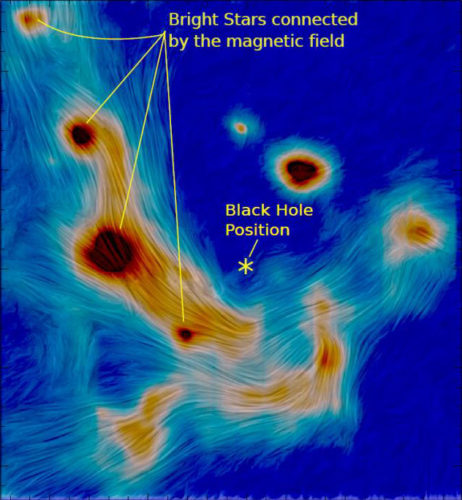
The magnetic field at the center of the Milky Way (Image E. Lopez-Rodriguez / NASA Ames / University of Texas at San Antonio)

An article published in the journal “Monthly Notices of the Royal Astronomical Society” describes the detailed mapping of the magnetic field around Sagittarius A*, also known simply as Sgr A*, the supermassive black hole at the center of the Milky Way. A team of researchers used the CanariCam infrared camera installed on the Grand Telescopio Canarias to obtain the data needed to reproduce the magnetic lines of gas and dust that orbit around the center of the galaxy. The structure of the magnetic lines gives the result a style that reminds of Vincent Van Gogh’s paintings.