Telescopes

Emissions from WISE1029 (Image ALMA (ESO/NAOJ/NRAO), Toba et al.)

An article published in “The Astrophysical Journal” describes a research on gas outflows from the center of an active galaxy. A team of astronomers used the ALMA radio telescope to observe highly ionized gas outflows caused by the supermassive black hole at the center of a dust-obscured galaxy (DOG) known as WISE1029+0501 or simply WISE1029 achieving surprising results. In fact, they detected the “signature” of carbon monoxide associated with the galactic disk but also discovered that the carbon monoxide gas in the galaxy isn’t influenced by the outflow of the strongly ionized gas launched from the galactic center, contradicting the models that seemed more plausible.

The hypernova DES16C2nm in the circle (Image M. Smith / DES Collaboration)

An article published in “The Astrophysical Journal” describes the confirmation that the supernova DES16C2nm is the most distant ever discovered. A team of astronomers led by the University of Southampton used data collected by the Dark Energy Survey (DES) and various telescopes to study it and classify it as a superluminous supernova (SLSN) or hypernova, the brightest and most rare type of supernova. The distance of the exploded star has been estimated at about 10.5 billion light years from Earth.

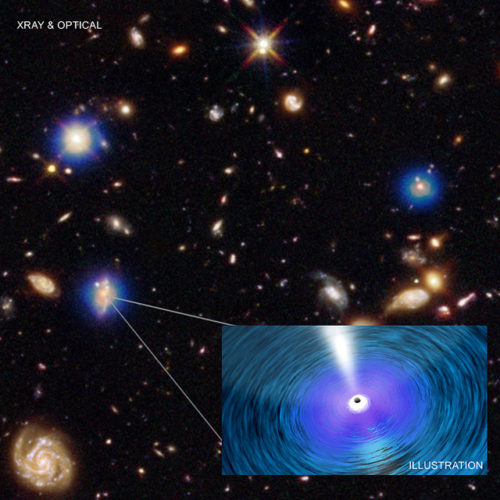
Supermassive black holes in the Chandra Deep Field-South (Image NASA/CXC/Penn. State/G. Yang et al and NASA/CXC/ICE/M. Mezcua et al.; Optical: NASA/STScI; Illustration: NASA/CXC/A. Jubett)

Two articles currently being published in the journal “Monthly Notices of the Royal Astronomical Society” describe two researches on the connection between the development of supermassive black holes and the galaxies that host them. Two separate teams used observations from NASA’s Chandra X-ray Observatory and other telescopes, concluding that supermassive black holes grow faster than new stars form in their host galaxies. This contradicts previous models that suggested a growth proportional to star formation in the galaxies.

M77's active galactic nucleus with the gas moving in the inset (Image ALMA (ESO/NAOJ/NRAO), Imanishi et al.)

An article published in the journal “Astrophysical Journal Letter” describes the best observation ever made of a ring of gas and dust surrounding a supermassive black hole. A team of astronomers used the ALMA radio telescope to observe the active galactic nucleus (AGN) of the M77 spiral galaxy that emits the intense electromagnetic radiation detected. This is the definitive proof of what was initially proposed as a theoretical concept for which increasingly clearer evidence was collected over time up to that presented in this research.

Hyperbolic trajectory of ʻOumuamua

An article published in the journal “Nature Astronomy” describes a research on the tumbling of the interstellar asteroid 1I/2017 U1, commonly known as ‘Oumuamua. According to a team of astronomers led by Queen’s University Belfast, that motion is due to an impact with another object that occurred before it was ejected from its solar system and could continue for at least another billion years.