
Telescopes

Artist's concept of TRAPPIST-1's planets with the Earth (Image ESO/M. Kornmesser)

Two articles, one published in the journal “Astronomy & Astrophysics” and one in the journal “Nature Astronomy”, describe two researches on the TRAPPIST-1 system’s rocky planets. Various telescopes, both space and ground-based, allowed to gather more information on those 7 exoplanets and to improve the measurements of their characteristics. An important result is the estimate of their density, which suggests that some of them are composed up to 5% of water. Spectroscopic detections suggest that at least 3 of them have a compact atmosphere that could allow liquid water to exist on their surface.

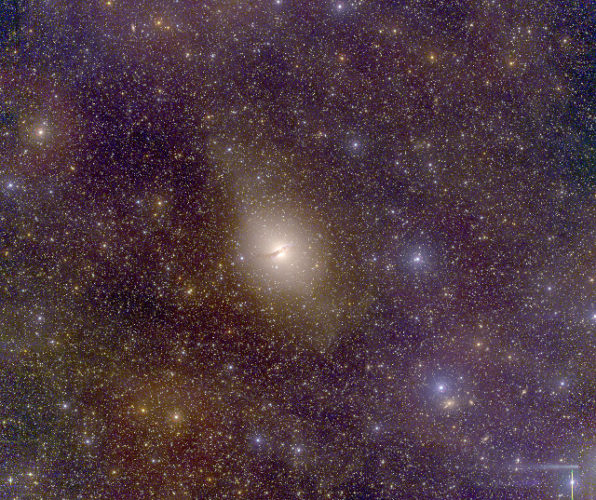
Centaurus A and its dwarf satellite galaxies (Image Christian Wolf and the SkyMapper team / Australian National University)

An article published in the journal “Science” describes a research that shows what appears to be a discrepancy between the observations of a group of galaxies and the current models about dark matter. A team of astronomers determined that 14 of the 16 dwarf satellite galaxies of the Centaurus A galaxy follow a common movement pattern and are arranged on a plane instead of moving in a chaotic way with a random arrangement around the central galaxy.

The Large Magellanic Cloud, the area N113 and the molecules detected (Image NRAO/AUI/NSF; ALMA (ESO/NAOJ/NRAO); Herschel/ESA; NASA/JPL-Caltech; NOAO)

An article published in the journal “The Astrophysical Journal Letters” describes the detection of hot cores and the most complex molecules detected outside the Milky Way in the Large Magellanic Cloud, one of the Milky Way’s satellite dwarf galaxies. A team led by astronomer Marta Sewilo of NASA’s Goddard Space Flight Center used the ALMA radio telescope to conduct those measurements that contradict previous observations in what was considered a chemically primitive galaxy.

Size comparison between the Sun and TRAPPIST-1 (Image ESO)

An article published in the journal “The Astrophysical Journal” describes the most accurate measurement of the characteristics of the ultra-cold dwarf star TRAPPIST-1. A team led by astronomer Valérie Van Grootel of the University of Liège in Belgium used new observations and analysis techniques to refine the measurements of TRAPPIST-1. It’s become the subject of a lot of research after the confirmation in February 2017 that 7 rocky planets orbit this tiny star and knowing its characteristics with precision helps to study the whole system.

Artist's concept of a star in formation with signals from methanol (Image courtesy Wolfgang Steffen/Boy Lankhaar et al. (molecules: Wikimedia Commons/Ben Mills))

An article published in the journal “Nature Astronomy” describes a research that provides a way to use methanol to measure magnetic fields existing in space. A team of researchers led by Boy Lankhaar of the Chalmers Univerisity in Gothenburg, Sweden, studied the properties of methanol to use it in the calculation of magnetic fields that play an important role in the formation of massive stars.