Telescopes

Artist's concept of the exoplanet 55 Cancri e and its star (Image NASA/JPL-Caltech)

An article published in the magazine “The Astronomical Journal” describes a research on the exoplanet 55 Cancri e. This super-Earth is one of the most studied among the planets in other solar systems but its extreme characteristics and the often experimental nature of the studies carried out provided partial and sometimes contradictory results. Now a analysis of data gathered using NASA’s Spitzer Space Telescope convinced a team of researchers that 55 Cancri e has an atmosphere and could have a composition similar to that of the Earth.

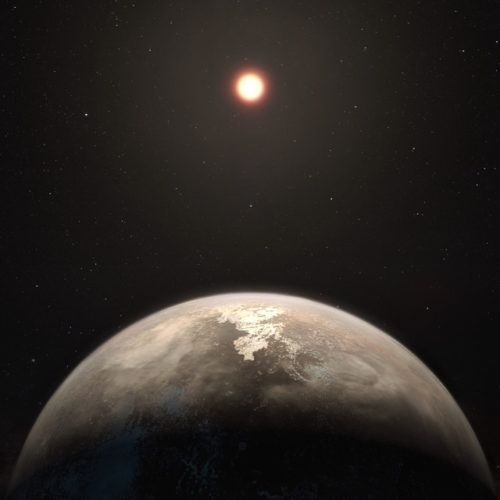
Artist's impressione of the exoplanet Ross 128 b and its star (Image ESO/M. Kornmesser)

An article published in the journal “Astronomy & Astrophysics” describes the discovery of the exoplanet Ross 128 b, which might be similar to Earth with a mass of at least 35% higher than the Earth’s. A team of researchers used the HARPS instrument at the Silla Observatory in Chile to discover this planet about 11 light years from Earth. Its orbit might be in ​its system’s habitable zone making it the second exoplanet closest to the solar system with those characteristics after Proxima b.

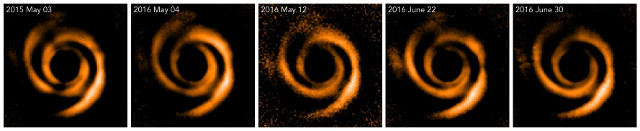
The HD 135344B system

An article published in the magazine “The Astrophysical Journal” describes a research on the protoplanetary disk surrounding the star HD 135344B. A team led by Tomas Stolker of the ETH in Zurich, Switzerland, used the SPHERE instrument mounted on ESO’s VLT (Very Large Telescope) to monitor the evolution of that dust and gas disk and of the dark bands that appear as shadows projected on it. Probably there are processes in the disk’s inner area that cause shadows on its outer area.

The first iPTF14hls explosion (Image courtesy Arcavi et ​al. ​2017, ​Nature)

An article published in the journal “Nature” describes the discovery of a supernova that seems to have exploded more than once. Called iPTF14hls, it was identified in 2014 by the Intermediate Palomar Transient Factory but in that position a supernova had already been recorded in 1954. It could be the first case discovered of a type of supernova called a pulsational pair-instability supernova, in which a star is so hot and massive that it produces in its core antimatter that causes periodic explosions.

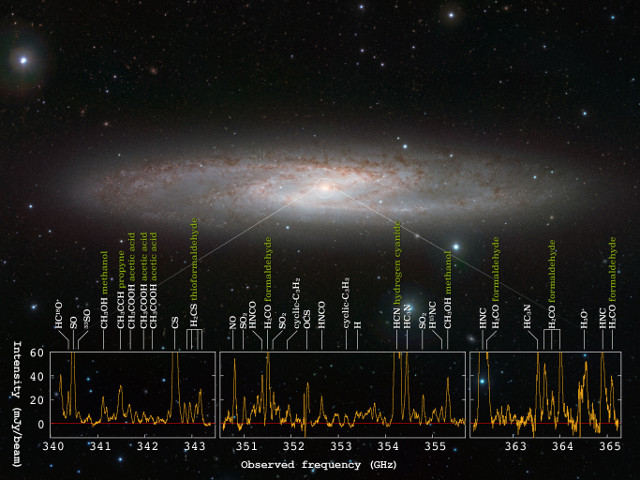
The galaxy NGC 253 with its molecules (Image ESO/J. Emerson/VISTA, ALMA (ESO/NAOJ/NRAO), Ando et al. Acknowledgment: Cambridge Astronomical Survey Unit)

An article published in “The Astrophysical Journal” describes the discovery of 8 molecular clouds within the galaxy NGC 253 in which 19 different complex molecules have been identified. A team of researchers led by Ryo Ando of the University of Tokyo used the ALMA radio telescope to detect the “signatures” of those molecules including thioformaldehyde, methanol, acetic acid, hydrogen cyanide, propyne and other organic molecules, the first detection of that kind outside the Milky Way.