Telescopes

Artist's concept of the Proxima Centauri system (Image ESO/M. Kornmesser)

An article published in the magazine “Astrophysical Journal Letters” describes the discovery of a cold dust ring around Proxima Centauri, the star closest to the solar system. A team of researchers led by Guillem Anglada from the Instituto de Astrofísica de Andalucía (CSIC), Granada, Spain, used the ALMA radio telescope to locate that ring that extends for a distance between one and four times that of the Earth from the Sun. There might also be a second ring, much farther from its star, a situation that makes the researchers think of a complex solar system.

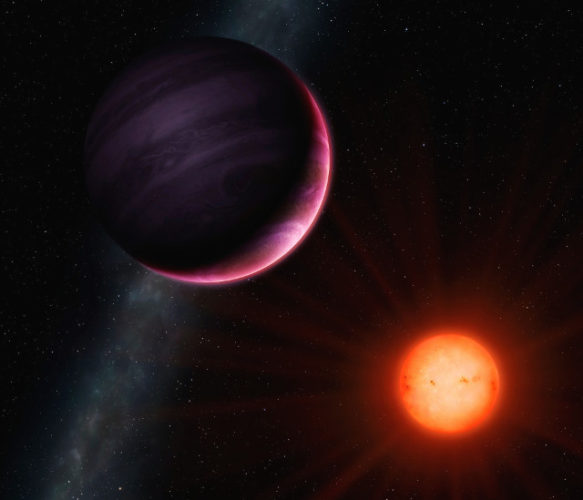
Artist's impression of the planet NGTS-1b and its star (Image University of Warwick/Mark Garlick)

An article published in the magazine “Monthly Notices of the Royal Astronomical Society” describes the discovery of a hot Jupiter-type gas giant planet orbiting the star NGTS-1, a red dwarf. This is an extraordinary pair that’s in conflict with the current planetary formation models. The exoplanet NGTS-1b is the first to be discovered with the new Next Generation Transit Survey (NGTS) instrument installed at ESO’s Paranal Observatory in Chile.

Aurora at Jupiter's North Pole (Image NASA / ESA / J. Nichols (University of Leicester))

An article published in the journal “Nature Astronomy” describes a research on the auroras on the planet Jupiter. A team of researchers used ESA’s XMM-Newton and NASA’s Chandra space telescopes to observe the pulsations of Jovian auroras. The study shows that the auroras pulsate independently at the two poles, unlike what happens on Earth.

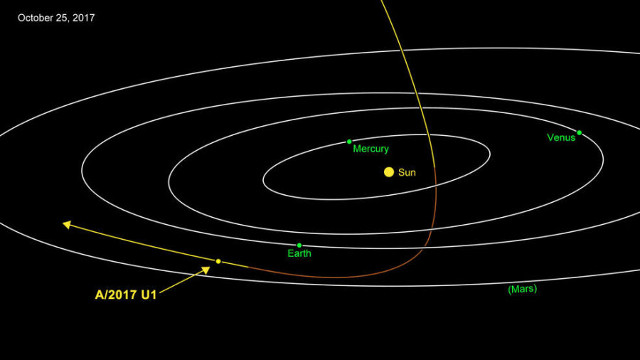
A/2017 U1's trajectory through the solar system (Image NASA/JPL-Caltech)

The announcement of the discovery of a possible asteroid coming from another solar system is a big deal. Named as A/2017 U1, it was detected on October 19 by the Pan-STARRS 1 telescope in Hawaii, part of a sky observation system normally used to detect celestial bodies of various kinds. Its motion seems incompatible with the trajectories of asteroids and comets gravitationally bound to the Sun so it could be the first celestial body discovered that came from another star, perhaps Vega.

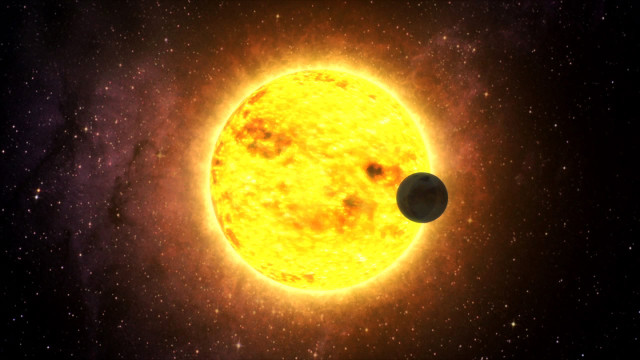
Artist's concept of ultra-short-period exoplanet and its star (Image NASA’s Goddard Space Flight Center / TESS / MIT / Lincoln Laboratory)

An article accepted for publication in “The Astronomica Journal” describes the discovery of a planet that orbits EPIC 228732031, a star just a little smaller than the Sun. A team of researchers used NASA’s Kepler space telescope to detect traces of the transits of the exoplanet that was called EPIC 228732031b. This type of discovery has become common but in this case it’s a super-Earth whose orbit is very close to its star, so much that its year only lasts 8.9 hours.