Telescopes

The galaxy NGC 4993 seen from several different ESO telescopes (Image VLT/VIMOS. VLT/MUSE, MPG/ESO 2.2-metre telescope/GROND, VISTA/VIRCAM, VST/OmegaCAM)

Yesterday ESO and LIGO/VIRGO collaboration held a press conference to present the results of a complex research that led to the discovery of the merger of two neutron stars observed in the emission of both electromagnetic and gravitational waves. These findings were collected in a series of articles that were published or will be published in the magazines “Nature”, “Nature Astronomy”, “Astrophysical Journal Letters” and “Physical Review Letters”.

Artist's concept of Haumea with its ring (Image courtesy IAA-CSIC/UHU)

An article published in the journal “Nature” describes the discovery of a ring around the dwarf planet Haumea. A team led by astronomers at the Astrophysical Institute of Andalucía (Instituto de Astrofísica de Andalucía, IAA-CSIC) in Spain used observations of several telescopes to find the ring, the first located around a trans-neptunian object, and to get better estimates of other Haumea characteristics.

The supernova MUSSES1604D (Image courtesy Institute of Astronomy, the University of Tokyo)

An article published in the journal “Nature” describes a research that provides evidence that the explosion of a supernova was triggered by the detonation of a helium layer on the surface of a white dwarf. A team of researchers led by Ji-an Jiang of the University of Tokyo used the Subaru telescope with follow-up observations using the Gemini-North telescope to study MUSSES1604D, a type Ia supernova. Their conclusion is that a white dwarf stole helium from a companion star and it formed a layer that at one point exploded, triggering the supernova.

Illustration of the possible dust cloud around Tabby's star (Image NASA/JPL-Caltech)

An article published in “The Astrophysical Journal” describes a research that offers an explanation of the many sudden brightness changes observed in Tabby’s star in recent years. A team of researchers co-ordinated by the University of Arizona used data collected by NASA’s Spitzer and Swift space telescopes and the Belgian AstroLAB IRIS observatory concluding that this phenomenon is caused by a dense cloud of dust orbiting the star.

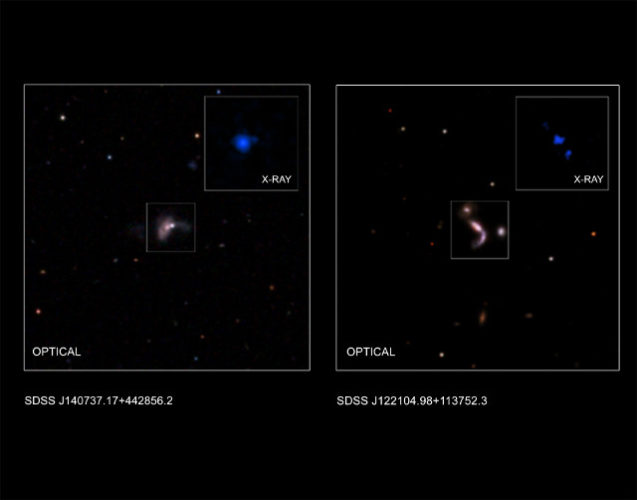
Two possible pairs of supermassive black holes

Two articles, one recently accepted for publication in “The Astrophysical Journal” and one published in the journal “Monthly Notices of the Royal Astronomical Society” (MRAS), describe as many researches on pairs of supermassive black holes. In total, five candidates could form as many pairs of black holes with masses millions of times the Sun’s at the center of galaxies. At a time when gravitational wave research obtained historical results, very powerful sources could be very useful for new studies.