Telescopes

V766 Cent and its companion (Image ESO/M. Wittkowski (ESO))

An article accepted for publication in the journal “Astronomy & Astrophisics” describes a study on the star V766 Cent, also known as the HR 5171 A, the largest yellow hypergiant discovered so far. A team of researchers used ESO’s Very Large Telescope Interferometer (VLTI) to conduct new observations and compare them to the previous ones. The observation of the evolution of V766 Cent is made more complicated by the fact that a companion passes in front of it.

The galaxy NGC 4490 (Image ESA/Hubble, NASA)

An image of the galaxy NGC 4490 captured by the Hubble Space Telescope shows in detail its distorted shape. That’s the result of a clash with the smaller galaxy NGC 4485, which millions of years ago went through its bigger neighbor. Probably this is just the beginning of the merger between the two galaxies but for now this clash has created among other things the conditions for the formation of new stars within NGC 4490.

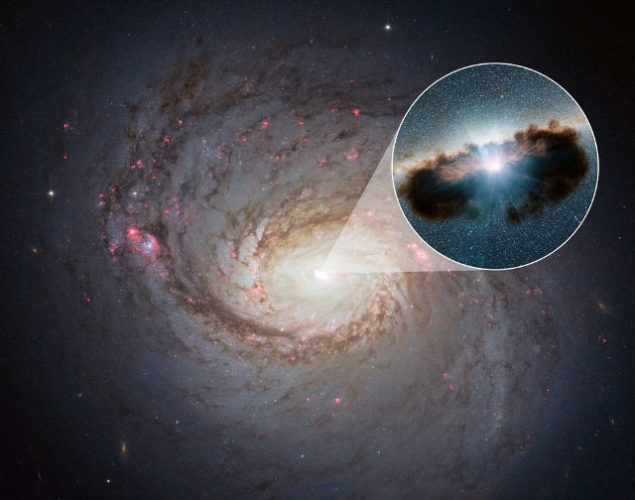
The galaxy NGC 1068 with its active galactic nucleus (Image NASA/JPL-Caltech)

An article published in the journal “Nature Astronomy” describes a research about the relationship between Active Galactic Nuclei (AGNs) and the galaxies that host them. Cristina Ramos Almeida of the Instituto de Astrofísica de Canarias (IAC) and Claudio Ricci of the Institute of Astronomy of the Universidad Católica de Chile used data collected by various space and ground-based telescopes to understand the effect of that activity, called in jargon AGN feedback, which can manifest in different ways, favoring or inhibiting star formation in their galaxies.

The star U Antliae with its gas bubble (Image ALMA (ESO/NAOJ/NRAO)/F. Kerschbaum)

An article published in the journal “Astronomy & Astrophysics” describes a research on U Antliae, a rather exotic red giant star. A team of researchers used the ALMA radio telescope to study the bubble of ejected materials that surrounds U Antliae to better understand the evolution of stars in the last stages of their life cycle. That’s a turbulent period in which they can visibly change their volume and their brightness in relatively short times.

Artist's impression of the exoplanet WASP-12b and its star (Image NASA, ESA, and G. Bacon (STScI))

An article published in the journal “The Astrophysical Journal Letters” describes a research on the exoplanet WASP-12b. A team of astronomers from the McGille University, Canada, and the University of Exeter, UK, used the Space Telescope Imaging Spectrograph (STIS), an instrument of the Hubble Space Telescope discovering that the planet reflects only a very little percentage of the light it receives from its star. In a word, this strange planet is darker than fresh asphalt: in technical terms, its albedo is 0.064.