Telescopes

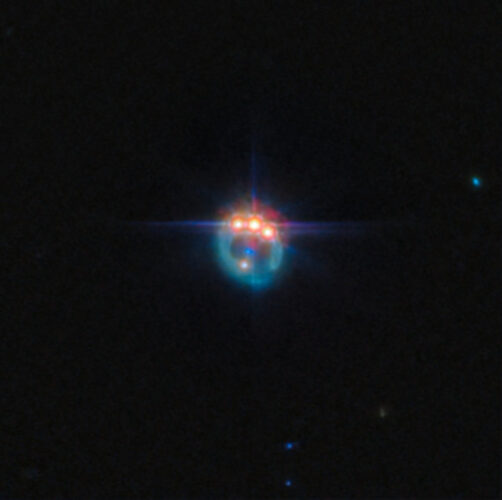
The quasar cataloged as RX J1131-1231, or simply RX J1131 (Image ESA/Webb, NASA & CSA, A. Nierenberg)

A new image captured by the James Webb Space Telescope depicts the quasar cataloged as RX J1131-1231, or simply RX J1131. About six billion light-years away from Earth, it’s visible in three different copies, recognizable in the upper part of the bright ring in the center of the image, due to a gravitational lensing effect generated by a galaxy between it and Earth. In particular, MIRI (Mid-Infrared Instrument) was used to observe RX J1131 with different mid-infrared filters as part of an observation program that studies dark matter.

The protostar forming within the L1527 molecular cloud observed by the James Webb Space Telescope's MIRI instrument

A new image captured by the James Webb Space Telescope reveals new details of a protostar forming within the molecular cloud cataloged as L1527. The MIRI instrument offered new information on the ongoing processes that are leading to the birth of a new star. An accretion disk is barely visible edge-on and is important because the protostar is still absorbing materials from it and planets could form within it in the future. During its formation, the protostar emits jets of gas that collide with the remains of the surrounding cloud, generating the structures MIRI sees in a color that is blue in the top image (NASA, ESA, CSA, STScI) thanks to the presence of polycyclic aromatic hydrocarbons (PAHs), compounds that are common in space.

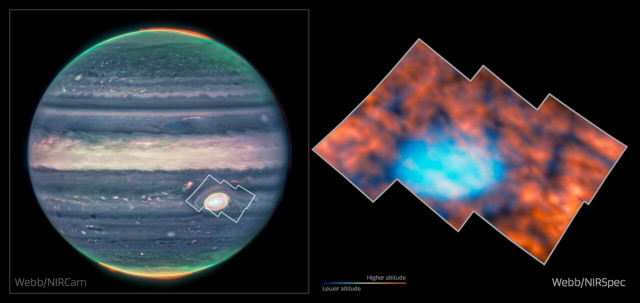
On the left the planet Jupiter seen by the James Webb Space Telescope's Near-Infrared Camera (NIRCam) instrument and on the right the Great Red Spot observed by the Near-InfraRed Spectrograph (NIRSpec) instrument

An article published in the journal “Nature Astronomy” reports the identification of structures in the planet Jupiter’s upper atmosphere above the Great Red Spot, the iconic storm larger than the Earth. A team of researchers led by Henrik Melin of the British University of Leicester used observations conducted with the James Webb Space Telescope to obtain new details of that area. The surprise came from the identification of intricate structures including dark arcs and bright spots in the observed area.

The Serpens Nebula observed by the James Webb Space Telescope

An article accepted for publication in “The Astrophysical Journal” reports the first detection of aligned bipolar jets emitted by protostars in the Serpens Nebula. A team of researchers used observations conducted with the James Webb Space Telescope to obtain the details needed to spot these jets. Typically, they have different orientations within a star-forming region but in this case, they are aligned almost perfectly. This suggests that star formation may be at a unique time in its history in the Serpens Nebula and provide crucial information about these processes.

The pair of quasars photographed by the Hyper Suprime-Cam mounted on Subaru Telescope

An article published in the journal “The Astrophysical Journal Letters” reports the discovery of the most distant pair of merging quasars known. A team of researchers combined observations from the Subaru Telescope with the Gemini North Telescope to find traces of this pair of quasars that we see as they were about 900 million years after the Big Bang.
Studying this pair of quasars can offer new insights into the epoch of reionization, the period that began about 400 million years after the Big Bang and was crucial in the history of the universe. That’s the time when the neutral, light-blocking hydrogen was ionized, resulting in the universe becoming the bright place we know today. An article accepted for publication in a journal of the American Astronomical Society offers further analysis based on observations conducted with the ALMA radio telescope.