Telescopes

The Kepler mission's exoplanet candidates (Image NASA/Ames Research Center/Wendy Stenzel)

At a press conference, NASA presented the new catalog of exoplanet candidates produced thanks to the observations of its Kepler space telescope. Exoplanet candidates are a total of 4,034 of which 2,335 have been confirmed as actually existing. There are 219 new candidates, of which 10 might be similar to Earth and at the same time be in ​​their solar system’s habitable zone.

A pair of stars in their dense core within the Perseus cloud (Image courtesy SCUBA-2 survey image by Sarah Sadavoy, CfA)

An article published in the journal “Monthly Notices of the Royal Astronomical Society” describes a study on the diffusion of binary systems composed of low-mass stars. The astronomers Sarah Sadavoy of the Smithsonian Astrophysical Observatory and Steven Stahler of the University of Berkeley studied very young stars in the molecular cloud of the constellation of Perseus concluding that that kind of stars is always born in pairs, including the Sun.

Orion KL Source I seen by ALMA (Image ALMA (ESO/NAOJ/NRAO), Hirota et al.)

An article published in the journal “Nature Astronomy” describes a study of the massive newborn baby star Orion KL Source I. A team of astronomers led by Tomoya Hirota used the ALMA radio telescope to capture what was called the birth cry of that star and determine that its outflow’s motion and shape indicate that the interaction of centrifugal and magnetic forces in a disk surrounding the star plays a crucial role in that cry.

An area of Margaritifer Terra and Erythraeum Chaos (Image ESA/DLR/FU Berlin, CC BY-SA 3.0 IGO)

ESA has released new images of a crater with a diameter of about 70 kilometers in the region of the planet Mars called Margaritifer Terra. This is a composite of two images captured by the Mars Express Space space probe’s High Resolution Stereo Camera (HRSC) instrument almost exactly 10 years away in March 2007 and February 2017. The crater and the surrounding area show yet again evidence of the presence of liquid water in Mars’ distant past.

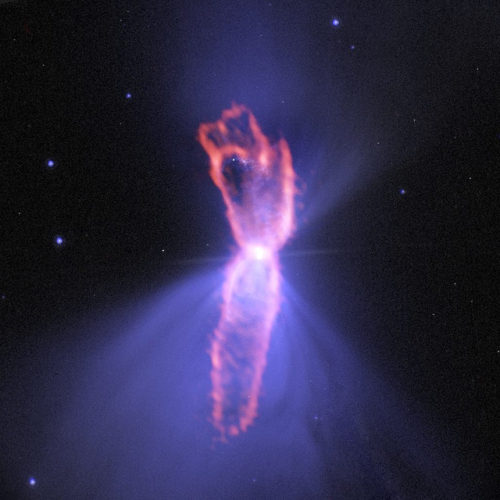
The Boomerang Nebula seen by ALMA and Hubble (Image ALMA (ESO/NAOJ/NRAO); NASA/ESA Hubble; NRAO/AUI/NSF)

An article published in “The Astrophysical Journal” describes a research about the Boomerang Nebula, described as the coldest spot in the universe. A team led by Raghvendra Sahai of NASA’s Jet Propulsion Laboratory used the ALMA radio telescope to understand why the outflow of materials from the star at the center of the nebula is expanding very quickly. According to the astronomers there’s a companion and the gravitational interactions between the two stars accelerated that outflow.