Telescopes

Artist's concept of the star KELT-9 and the planet KELT-9b (Image NASA/JPL-Caltech)

An article published in the journal “Nature” describes the study of the planet KELT-9b. This is an extreme case of hot Jupiter, a gas giant planet like Jupiter so close to its star to be considerably heated up. KELT-9b has an estimated surface temperature in the area exposed to its star that can exceed 4,600 Kelvin, so much that its atmosphere is likely to be dissipating in space and may have a tail similar to that of comets.

Chandra Deep Field-South and illustration of a supermassive black hole (Image X-ray: NASA/CXC/Univ. of Rome/E.Pezzulli et al. Illustration: NASA/CXC/M.Weiss)

An article published in the journal “Monthly Notices of the Royal Astronomical Society” describes a research about the growth mechanisms of supermassive black holes. A team of six Italian researchers led by Edward Pezzulli, a PhD student of the National Institute for Astrophysics (INAF) in Rome proposed a model that predicts that these objects can reach masses even billions of times the Sun’s not with a steady growth but with periodic “meals” that are very quick during whith they swallow huge amounts of materials.

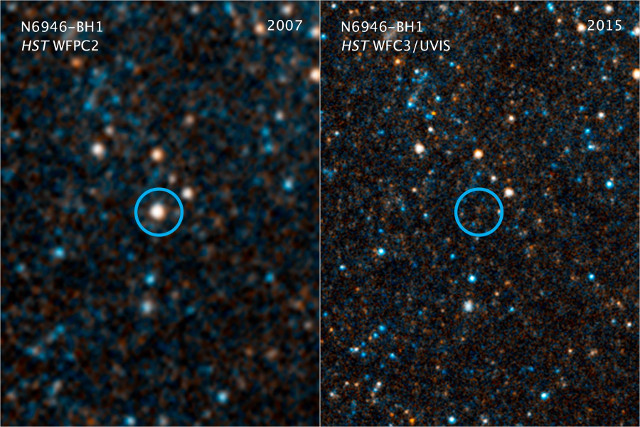
The area where the star N6946-BH1 used to be before and after its disappearance (Image NASA/ESA/C. Kochanek (OSU))

An article published in the journal “Monthly Notices of the Royal Astronomical Society” describes the discovery of a massive star called N6946-BH1 that collapsed and seems to have formed a black hole directly without exploding into a supernova. A team of astronomers led by Christopher Kochanek used the Large Binocular Telescope (LBT) in Arizona and NASA’s Hubble and Spitzer space telescopes to observe for the first time this phenomenon, which could explain why there are less supernovae than expected.

Artist's concept of galaxies merging near a quasar (Image MPIA using material from the NASA/ESA Hubble Space Telescope)

An article published in the journal “Nature” describes the discovery of four galaxies that are very ancient, so much that they formed less than a billion years after the Big Bang. A very high stellar formation rate was observed within them. A team of astronomers led by Roberto Decarli of the Max Planck Institute for Astronomy discovered by chance these four galaxies, noting that they were close to as many quasars.

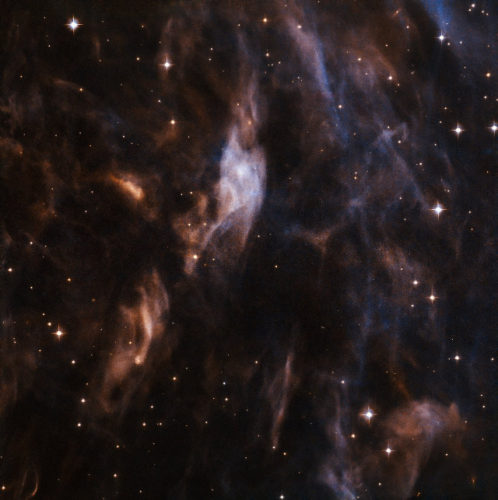
A part of the Sh2-308 nebula (Image ESA/Hubble & NASA)

An image captured by the Hubble Space Telescope shows part of a nebula called Sh2-308 surrounding the star EZ Canis Majoris, a Wolf-Rayet star, a rare type of very massive star, over twenty times the mass of the Sun, and very hot that emits very strong solar winds. The star and the nebula are closely linked because the very strong solar winds push large amounts of ionized hydrogen that form a kind of temporary bubble around it.