Telescopes

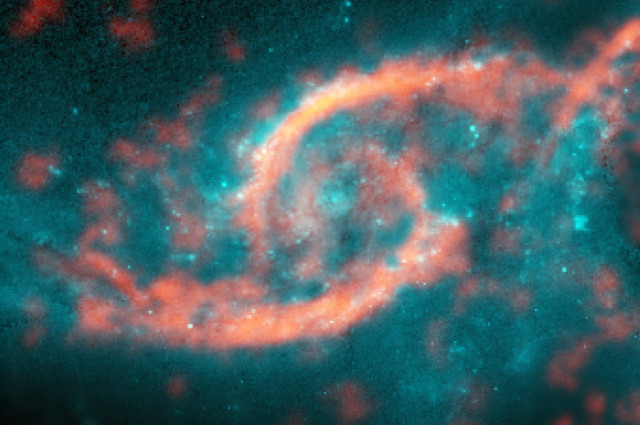
The galaxy IC 2163 (Image M. Kaufman; B. Saxton (NRAO/AUI/NSF); ALMA (ESO/NAOJ/NRAO); NASA/ESA Hubble Space Telescope)

An article published in “Astrophysical Journal” describes a research about the eye-shape galaxy IC 2163, due to a collision with another galaxy called NGC 2207. A team of researchers led by astronomer Michele Kaufman used the ALMA radio telescope to study this kind of tsunami of stars and gas that took on a very rare form among the known galaxies.

Artistic representation of the galactic encounter that generated B3 1715+425 (Image Bill Saxton, NRAO/AUI/NSF)

An article published in the “Astrophysical Journal” describes the discovery of the remnants of a galaxy of which only a small core remained after passing through a larger galaxy. A team of astronomers used the VLBA radio telescope to find this unique object cataloged as B3 1715+425 with a diameter that is now only 3,000 light-years and a supermassive black hole at its center.

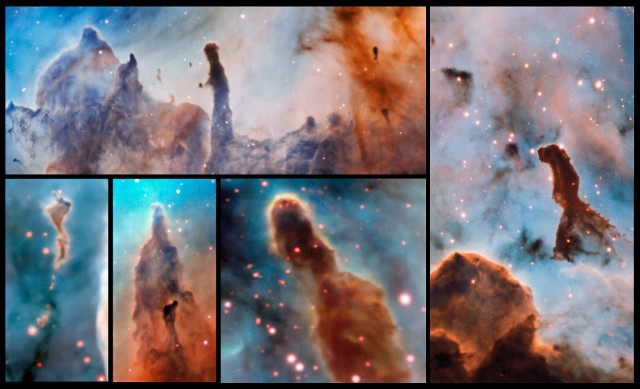
Pillars within the Carina Nebula (Image ESO/A. McLeod)

An article accepted for publication in the journal “Monthly Notices of the Royal Astronomical Society” describes a research on the large columnar structures in the Carina Nebula. A team led by Anna McLeod, a PhD student at ESO, used the MUSE instrument installed on ESO’s VLT (Very Large Telescope) to examine these structures that have been nicknamed “pillars of destruction” for certain similarities with the “Pillars of Creation” photographed by the Hubble space telescope.

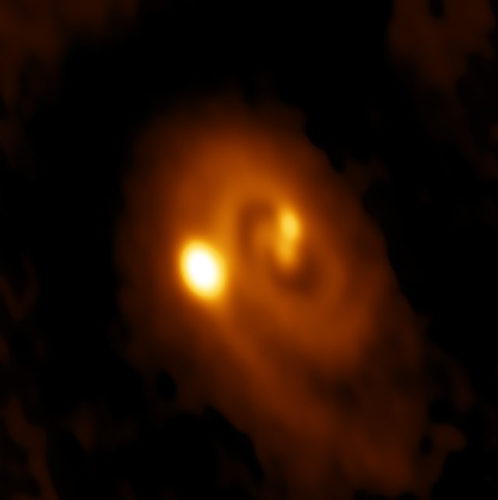
The L1448 IRS3B system (Image Bill Saxton, ALMA (ESO/NAOJ/NRAO), NRAO/AUI/NSF)

An article published in the journal “Nature” describes the discovery of a triple system in formation. An international team of scientists used the Atacama Large Millimeter / submillimeter Array (ALMA) and Karl G. Jansky Very Large Array (VLA) radio telescopes to observe the system called L1448 IRS3B, where a disk of dust and gas is fragmenting into a multiple star system.

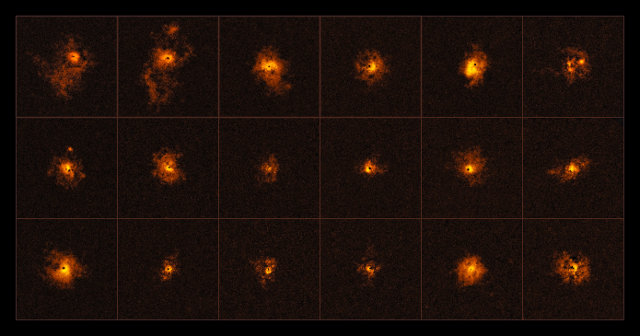
18 of the quasars studied (Image ESO/Borisova et al.)

An article to be published in “The Astrophysical Journal” describes an investigation into the glowing gas clouds around distant quasars. An international team of astronomers led by a group at the ETH (Swiss Federal Institute of Technology) in Zurich, Switzerland, used the MUSE instrument mounted on ESO’s Very Large Telescope (VLT) to look at very distant galaxies that are active, of the type called quasar, and discovered that the gas halos that surround them are more common than expected.