Telescopes

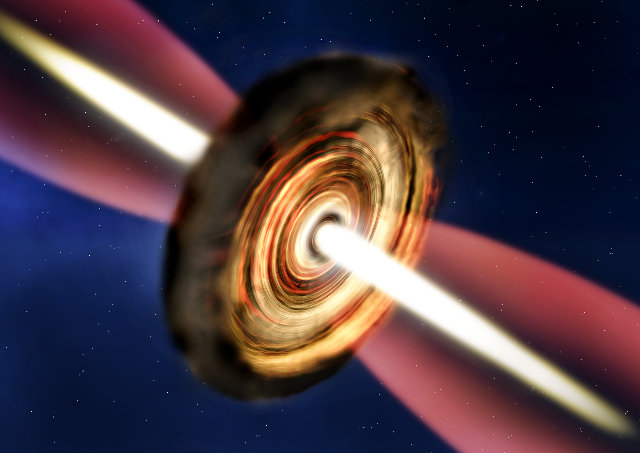
Artist's concept of G11.92-0.61 MM1 with the keplerian disc around it (Image courtesy A. Smith (Institute of Astronomy, Cambridge))

An article published in the journal “Monthly Notices of the Royal Astronomical Society” describes the discovery of a protostar called G11.92-0.61 MM1. A team of astronomers led by John Ilee from the University of Cambridge’s Institute of Astronomy, UK, identified this object in a key stage in the birth of a star. It has a mass that is already more than thirty times that of the Sun and is still attracting materials from the molecular cloud in which it’s forming.

The supernova remnants G11.2-0.3 (Photo X-ray: NASA/CXC/NCSU/K. Borkowski et al; Optical: DSS)

At the workshop “Chandra Science for the Next Decade” being held in Cambridge, Massachusetts, a new image was presented showing a supernova remnant called G11.2-0.3 obtained using NASA’s Chandra X-ray Observatory. For years these were considered the remnants of the supernova recorded by the Chinese in 386 A.D. and for this reason known as SN 386 but new exams indicate that it was a different supernova.

The molecular cloud behind the Orion Nebula seen by HAWK-I (left) and ALMA (right) (Image ESO/Goicoechea et al.)

An article published in the journal “Nature” describes a research about the molecular cloud located behind the Orion Nebula. A group of researchers used the HAWK-I instrument installed on ESO’s Very Large Telescope (VLT) and the ALMA radio telescope, both ESO’s, to look at key moments of astrochemical phenomena, meaning the chemical reactions that take place in space and in this case in that area and one day will lead to the birth of new stars.

The area around dwarf galaxy DDO 68 with a possible satellite seen by LBT (Image courtesy Francesca Annibali/INAF)

An article published in “The Astrophysical Journal Letters” describes a research about the dwarf galaxy DDO 68. An international team of researchers led by Francesca Annibali of the National Institute for Astrophysics (INAF), Italy, used the Large Binocular Telescope (LBT) to make observations that allowed to find evidence that even a very small galaxy can capture smaller galaxies.

Artistic representation of Io with its volcanoes and the atmosphere collapsing when it enters Jupiter's shadow (Image SwRI/Andrew Blanchard)

An article published in the “Journal of Geophysical Research” describes a research funded by NASA on the atmosphere of Io, one of the “Galilean” moons of Jupiter. A group of scientists led by Constantine Tsang of the Southwest Research Institute detected the changes taking place in the atmosphere of Io, noting how it collapses when it enters Jupiter’s shadow and the temperature drops.