Telescopes

Europa with the possible water vapor plumes coming from its south pole (Image NASA/ESA/W. Sparks (STScI)/USGS Astrogeology Science Center)

In a press conference, NASA announced that a team of astronomers led by Dr. William Sparks who observed Europa with the Hubble Space Telescope captured images of what might be plumes of water vapor and erupt from the surface of this planet moon Jupiter. They would be a confirmation of the existing subsurface activity with an ocean of liquid water, one of the best candidates to host life forms. The results of this research will be published in the “Astrophysical Journal”.

Galaxies rich in carbon monoxide seen in orange together with the ones seen by Hubble in blue (Image B. Saxton (NRAO/AUI/NSF); ALMA (ESO/NAOJ/NRAO); NASA/ESA Hubble)

A series of articles to be published in “Astrophysical Journal” and “Monthly Notices of the Royal Astronomical Society” describe different parts of a research based on the observation of the Hubble Space Telescope’s Ultra Deep Field (HUDF) using the radio telescope ALMA. These observations show that the rate of star formation in young galaxies is closely related to their total mass in stars.

The supernova remnants RCW103 with the magnetar 1E 1613 at its center (Image X-ray: NASA/CXC/University of Amsterdam/N.Rea et al; Optical: DSS)

Two articles, one published in “The Astrophysical Journal Letters” and one published in the journal “Monthly Notices of the Royal Astronomical Society”, describe as many research on the supernova remnants known as RCW103. At its center a neutron star formed called 1E 161348-5055 – or simply 1E 1613 – that has been puzzling astronomers for decades for its abnormal behavior. Now two teams independently offered the same explanation: the neutron star has the characteristics of a magnetar.

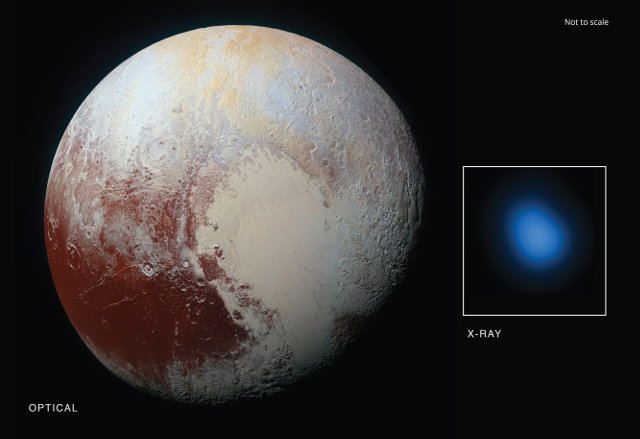
Pluto seen at visible light and at X-rays (not in scale) (Image X-ray: NASA/CXC/JHUAPL/R.McNutt et al; Optical: NASA/JHUAPL)

Two new research are connected in different ways to emissions coming from the dwarf planet Pluto. An article published in the journal “Icarus” describes a research which, through the use of the NASA’s Chandra X-ray Observatory, detected X-rays emissions from Pluto. Another article published in the journal “Nature” offers an explanation for the reddish color to Charon’s poles, caused by methane ripped from Pluto’s atmosphere and turned into ice by the low temperatures.

The globular cluster Terzan 5 seen by the MAD on the VLT (Image ESO/F. Ferraro)

An article published in “The Astrophysical Journal” describes a research on the globular cluster Terzan 5. An international team of astronomers led by Francesco Ferraro from the University of Bologna discovered that the stars of Terzan 5 are divided into two groups, one with an age of 12 billion years and one with an age of around 4.5 billion years, more or less like the Sun. This unique feature can help to better understand the evolution of the Milky Way.