Telescopes

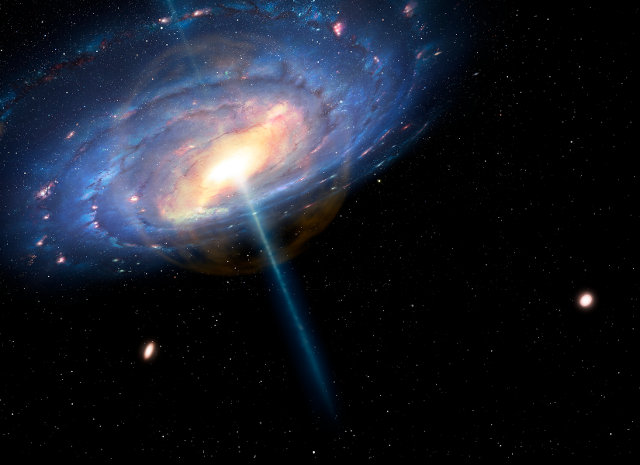
Artistic concept of the Milky Way as a Quasar (Image courtesy Mark A. Garlick/CfA)

An article published in “The Astrophysical Journal” describes a research about the Milky Way that offers a solution to the problem of the missing mass. A team of scientists led by Fabrizio Nicastro, a research associate at the Harvard-Smithsonian Center for Astrophysics (CfA) and astrophysicist at the Italian National Institute of Astrophysics (INAF), used ESA’s XMM-Newton space telescope to discover a kind of gaseous fog that absorbs emissions from distant sources. The existence of such a bubble indicates that some millions of years ago the Milky Way was a quasar.

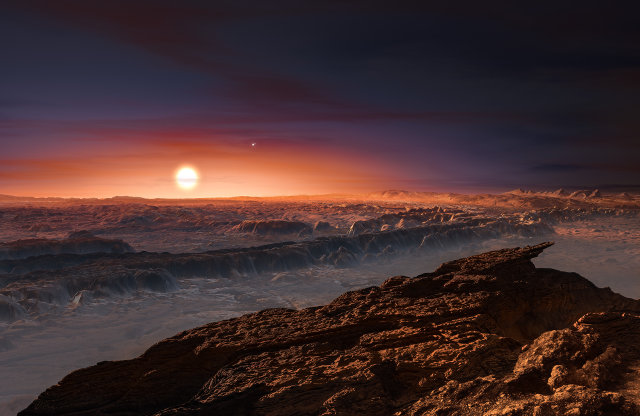
Artistic concept of Proxima b's surface. In the upper-right of Proxima Centauri there are Alpha Centauri A and B (Image ESO/M. Kornmesser)

Yesterday ESO held a press conference to announce that probably they discovered an exoplanet orbiting Proxima Centauri, the nearest star to the solar system. A team of astronomers led by Guillem Anglada-Escudé from Queen Mary University of London found what was called Proxima b, a planet a little more massive than the Earth orbiting in the habitable zone of its star.

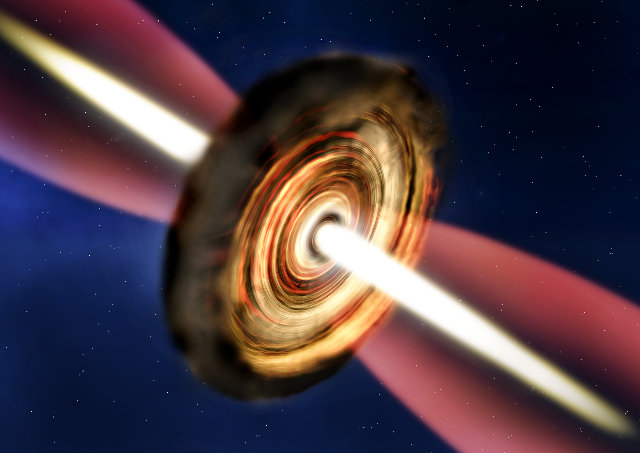
Artist's concept of G11.92-0.61 MM1 with the keplerian disc around it (Image courtesy A. Smith (Institute of Astronomy, Cambridge))

An article published in the journal “Monthly Notices of the Royal Astronomical Society” describes the discovery of a protostar called G11.92-0.61 MM1. A team of astronomers led by John Ilee from the University of Cambridge’s Institute of Astronomy, UK, identified this object in a key stage in the birth of a star. It has a mass that is already more than thirty times that of the Sun and is still attracting materials from the molecular cloud in which it’s forming.

The supernova remnants G11.2-0.3 (Photo X-ray: NASA/CXC/NCSU/K. Borkowski et al; Optical: DSS)

At the workshop “Chandra Science for the Next Decade” being held in Cambridge, Massachusetts, a new image was presented showing a supernova remnant called G11.2-0.3 obtained using NASA’s Chandra X-ray Observatory. For years these were considered the remnants of the supernova recorded by the Chinese in 386 A.D. and for this reason known as SN 386 but new exams indicate that it was a different supernova.

The molecular cloud behind the Orion Nebula seen by HAWK-I (left) and ALMA (right) (Image ESO/Goicoechea et al.)

An article published in the journal “Nature” describes a research about the molecular cloud located behind the Orion Nebula. A group of researchers used the HAWK-I instrument installed on ESO’s Very Large Telescope (VLT) and the ALMA radio telescope, both ESO’s, to look at key moments of astrochemical phenomena, meaning the chemical reactions that take place in space and in this case in that area and one day will lead to the birth of new stars.