Telescopes

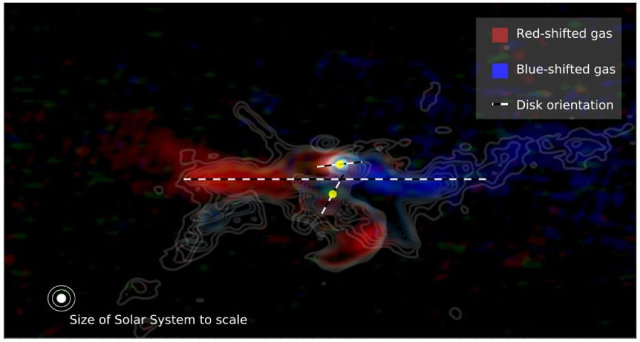
The IRS 43 system (Image courtesy Christian Brinch/NBI/KU)

An article published in “Astrophysical Journal Letters” describes a research on the IRS 43 system, which turned out to be really extraordinary because it’s formed by two very young stars each surrounded by a disk of gas but they share a third much bigger disk. A team of scientists from the Niels Bohr Institute, University of Copenhagen, used the ALMA radio telescope to discover this structure never seen before.

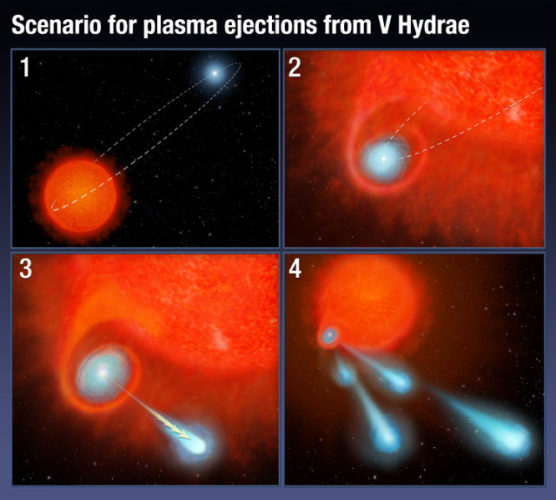
Sequence of interactions between V Hydrae and its companion that cause the ejection of plasma blobs (Image NASA, ESA, and A. Feild (STScI))

An article published in “The Astrophysical Journal” describes a research on the huge plasma blobs ejected by the red giant star V Hydrae. A team of astronomers led by Raghvendra Sahai of NASA’s JPL used the Hubble Space Telescope to study this phenomenon and concluded that the plasma blobs come from another star, a companion of V Hydrae that we can’t see.

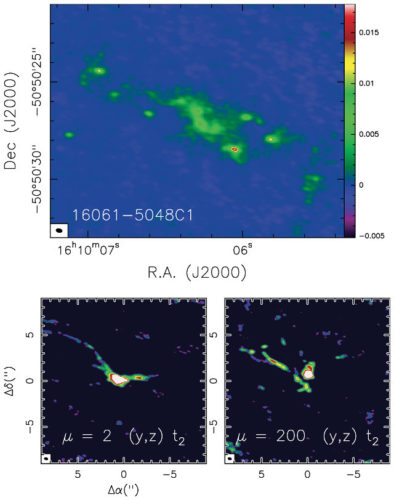
The molecular cloud IRAS 16061-5048C1 and in the lower panels images from computer simulations (Image courtesy Francesco Fontani/INAF)

An article published in the journal “Astronomy & Astrophysics” describes a research on a molecular cloud called IRAS 16061-5048C1. A team led by Francesco Fontani from INAF Arcetri Observatory, Italy, used the ALMA radio telescope to observe the fragmentation of clumps of materials distributed along a filamentary-like structure that could form the embryos of future stars and probably of solar systems.

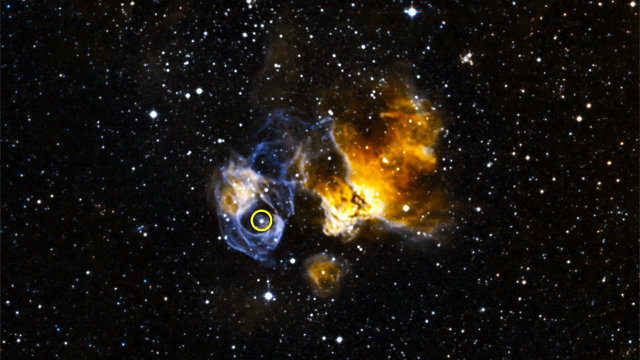
The supernova remnant DEM L241 with the gamma-ray binary LMC P3 in the circle (Image X-ray: NASA/CXC/SAO/F. Seward et al; Optical: NOAO/CTIO/MCELS, DSS)

An article published in “The Astrophyisical Journal” describes the discovery of the first gamma-ray binary found outside the Milky Way, called LMC P3. A team of researchers led by Robin Corbet at NASA’s Goddard Space Flight Center used the Fermi space telescope to discover this couple in the Large Magellanic Cloud formed by a giant blue star and a companion that might be a neutron star or a black hole that are interacting producing cyclic gamma-ray emission.