Telescopes

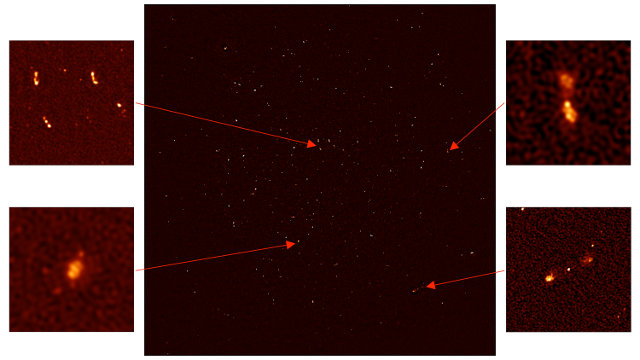
The galaxies seen by MeerKAT with some in details in the insets (Image courtesy SKA Africa. All rights reserved)

The radio telescope MeerKAT has been activated and the first images of the observations have been released. MeerKAT’s sensitivity was immediately demonstrated because in the observed area 70 galaxies were known but over 1300 have been detected. It’s a great achievement for one of the precursors of the SKA project, the next-generation radio telescope whose activation is scheduled for 2020.

Artistic concept of the V883 Orionis system with its protoplanetary disc and the snow in it (Image A. Angelich (NRAO/AUI/NSF)/ALMA (ESO/NAOJ/NRAO))

An article published in the journal “Nature” describes the first observation ever of the water snow line in the V883 Orionis system. Using the ALMA radio telescope, a team led by Lucas Cieza of the Universidad Diego Portales, Santiago, Chile, identified the distance from the star beyond which the temperature drops enough for water to freeze.

The galaxy cluster 3C 129 observed by various telescope (Image NRAO, ROSAT satellite; the Two Micron All Sky Survey)

An article published in the journal “Monthly Notices of the Royal Astronomical Society” is the first produced thanks to a study that includes observations of the Sardinia Radio Telescope (SRT). Its target was a supermassive black hole at the center of an elliptical galaxy about 300 million light years away from Earth that is falling toward the galaxy cluster 3C 129.

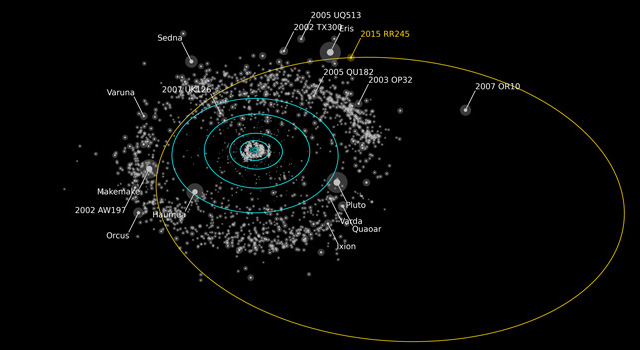
Scheme of the orbits of 2015 RR245 and the objects brighter than it (Image courtesy Alex Parker, OSSOS)

An international team of astronomers discovered the dwarf planet identified for now only as 2015 RR245. Using the telescope on Mount Maunakea, Hawaii, as part of the OSSOS survey, they found 2015 RR245, whose orbit is in the Kuiper belt, the area of ​​the solar system beyond Neptune where there are many icy celestial bodies.

The diameter of the dwarf planet 2015 RR245 has been estimated at around 700 kilometers (about 435 miles), which means it’s a bit smaller than Ceres. In the Kuiper belt there are 17 objects larger that that so this discovery is not at the level of that of a planet or at least of a dwarf planet the size of Pluto or Eris. However, each object discovered out there can tell us something more about the history of the solar system.

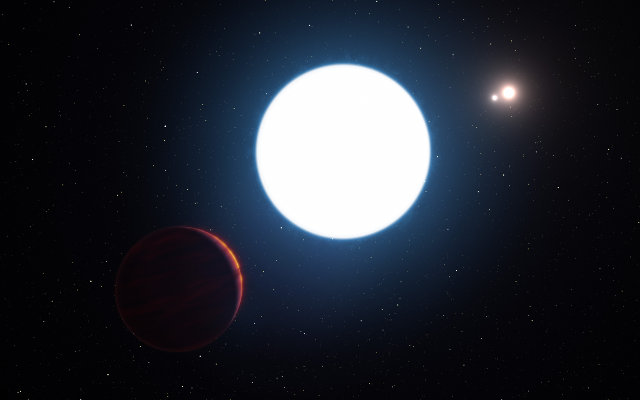
Artistic representation of the HD 131399 system with its exoplanet and its three stars (Image ESO/L. Calçada)

An article published in the journal “Science” describes the discovery of the exoplanet HD 131399Ab, the first ever found in a system with three suns. A team of astronomers led by the University of Arizona used the SPHERE instrument mounted on ESO’s VLT to obtain a direct image of HD 131399Ab and its system’s three stars. Scientists thought that such an orbit was unstable but this case seems to contradict that idea.