Telescopes

The galaxy NGC 6052 photographed by the Hubble Space Telescope (Image ESA/Hubble & NASA, Acknowledgement: Judy Schmidt)

NGC 6052 is a galaxy apparently abnormal because of its odd shape. It was initially classified in that way but later astronomers realized that it’s actually the result of an ongoing merger of two galaxies with similar masses. The Hubble space telescope was used to take a picture of NGC 6052 with its Wide Field Planetary Camera 2 (WFPC2), which includes observations in visible and ultraviolet light.

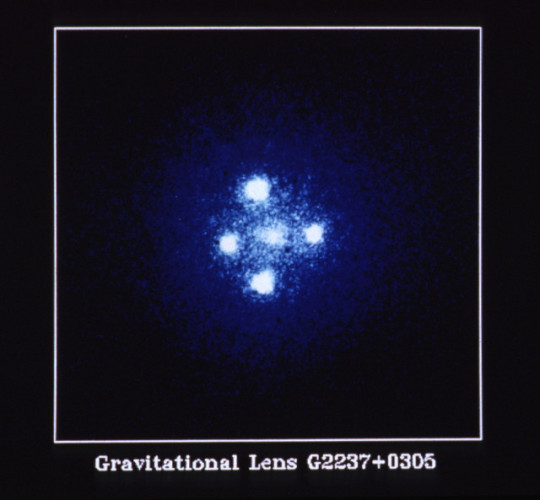
The quasar Q2237+0305 nicknamed Einstein Cross photographed by the Hubble Space Telescope (Image NASA, ESA, and STScI)

An article published in “The Astrophysical Journal Letters” describes a research on the quasar Q2237+0305 nicknamed Einstein Cross or Einstein’s Cross. Through the technique of gravitational microlensing a team of Spanish astrophysicists carried out the most accurate measures of the innermost region belonging to the disc of materials spinning around the supermassive black hole that feeds this quasar.

Galaxy NGC 1068 seen by the Hubble Space Telescope. In the circle there's an artist concept of the doughnut of gas and dust surrounding the supermassive black hole at its center (ImageNASA/JPL-Caltech)

An article published in the journal “Monthly Notices of the Royal Astronomical Society letters” describes a research on the supermassive black hole at the center of the galaxy NGC 1068. An international team of astronomers led by Andrea Marinucci of the Roma Tre University in Italy used ESA’s XMM-Newton and NASA’s NuSTAR space telescopes to study the giant doughnut-shaped structure around the supermassive black hole.

Image showing the observations of the supernova SN Refsdal. In the uppermost circle there's the possible observation happened in 1998, in the middle circe the 2015 observation and in the lowermost circle the 2014 observation

The Hubble Space Telescope allowed us to observe a supernova just during the explosion. This is due to the fact that its appearance was foretold. For the first time, the use of complex calculations related to the theory of relativity made it possible to capture the supernova nicknamed Refsdal when it exploded. It’s the first time such a feat was achieved by exploiting the gravitational lensing of that galaxy cluster MACS J1149.5 + 2223, which bent the light from that star showing the explosion several times in different areas of the sky.

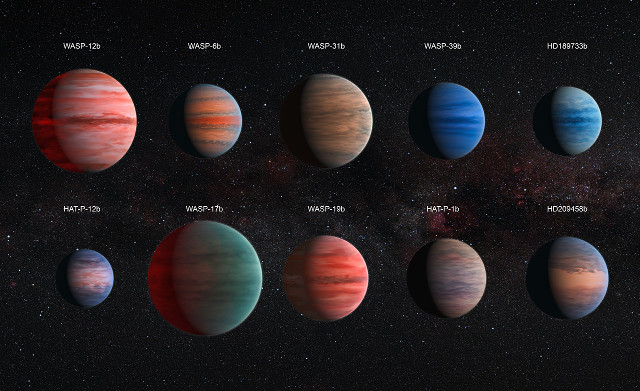
Artistic representation of the ten hot Jupiters examined in this research (Image NASA, ESA, and D. Sing (University of Exeter))

An article published in the journal “Nature” describes a research that provides an explanation to the apparent scarcity of water detected on some exoplanets of the type known as hot Jupiter. These are gas giants like Jupiter but orbit very close to their stars and consequently have very high surface temperatures. An international team of astronomers used the Hubble and Spitzer space telescopes to study ten exoplanets of this kind.