
Telescopes

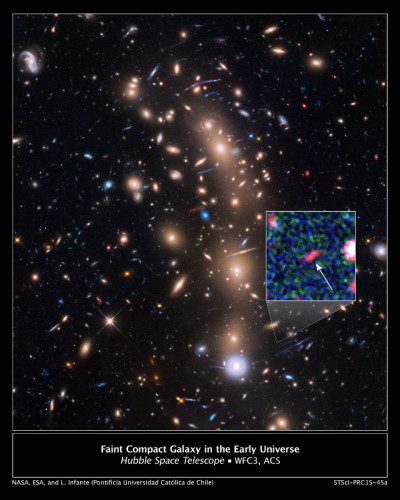
The galaxy cluster MACSJ0416.1-2403 observed by the Hubble Space Telescope with the galaxy nicknamed Tayna in the inset (Image NASA, ESA, and L. Infante (Pontificia Universidad Catolica de Chile))

An article published in the journal “Astrophysical Journal” describes the discovery of the faintest galaxy in the early universe. According to this study, this galaxy was born when the universe was “only” about 400 million years old and for this reason was nicknamed Tayna, which means “first born” in the Aymara language. To detect its light the gravitational lensing effect of a galaxy cluster was used. That allowed to capture the extremely dim light of a total of 22 ancient galaxies using the Hubble and Spitzer space telescopes.

Artistic illustration of the event ASASSN-14li with the accretion disk around the black hole and part of the materials from the shredded star forming a tail (Image Spectrum: NASA/CXC/U.Michigan/J.Miller et al.; Illustration: NASA/CXC/M.Weiss)

An article published in the journal “Science” describes the observations of a supermassive black hole with a mass a few millions times that of the Sun that destroyed a star with the consequent formation of a jet of matter moving at speeds close to that of light. This event, called ASASSN-14li, had already been described a few weeks ago in another study whose results were published in the journal “Nature”.

Image of the star VY Canis Majoris captured by the SPHERE instrument on VLT (Photo ESO)

An article published in the journal “Astronomy & Astrophysics” describes a study on the star VY Canis Majoris, one of the largest in the Milky Way. The SPHERE instrument installed on ESO’s VLT (Very Large Telescope) allowed to obtain very detailed images of this star making it possible to study the dust that surrounds it and the considerable mass it loses in time ejecting it.

The early massive galaxies just discovered marked in red circles (Image ESO/UltraVISTA team. Acknowledgement: TERAPIX/CNRS/INSU/CASU)

An article published in the journal “Astrophysical Journal” describes the discovery of the oldest giant galaxies carried out thanks to ESO’s VISTA (Visible and Infrared Survey Telescope for Astronomy) telescope. A team of astronomers led by Karina Caputi of the Kapteyn Astronomical Institute at the University of Groningen, Netherlands, identified galaxies that existed when the universe was between 750 million and 2.1 billion years old. This result is surprising because the birth of galaxies so massive wasn’t expected so soon.

Scheme of ALMA combined with the IRAM and VLBA radio telescopes (Image A. Angelich (NRAO/AUI/NSF))

The ALMA radio telescope is currently the world’s most powerful yet in recent months some experiments were carried out that made it even more powerful by working together with other radio telescopes to create a virtual instrument that may have a size similar to that of Earth. This was made possible by combining observations from ALMA with those from other radio telescopes located in other continents.