Telescopes

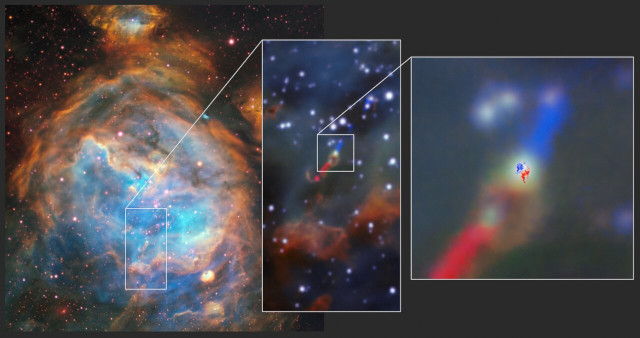
The HH 1177 system

An article published in the journal “Nature” reports the identification of a protoplanetary disk around the very young star cataloged as HH 1177 in the Large Magellanic Cloud, one of the dwarf galaxies satellite of the Milky Way. A team of researchers used the ALMA radio telescope to observe the disk in a follow-up study after observations conducted with the MUSE instrument mounted on the VLT allowed to see jets coming from the still-forming star. This is the first detection of a circumstellar disk in another galaxy. That type of structure is also called a Keplerian disk in jargon because it obeys the same laws as planetary motion.

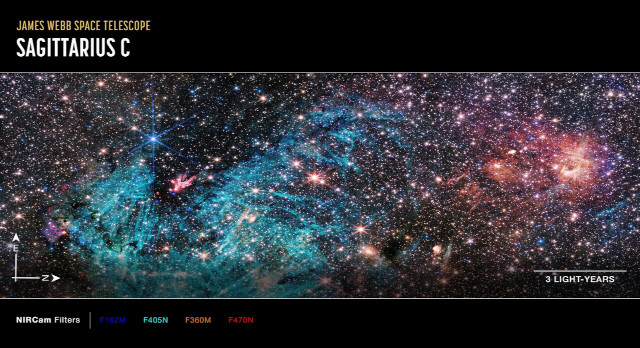
The area cataloged as Sagittarius C

An image captured with the James Webb Space Telescope shows a star-forming area cataloged as Sagittarius C just 300 light-years away from Sagittarius A*, the supermassive black hole at the center of the Milky Way. In the heart of the galaxy, among half a million stars, there’s a cluster of protostars in the middle of a cloud so dense that the stars behind it are obscured even to the most powerful existing telescope. In contrast, protostars are visible to the NIRCam instrument in detail along with cosmic features that were previously unknown and astronomers have yet to identify.

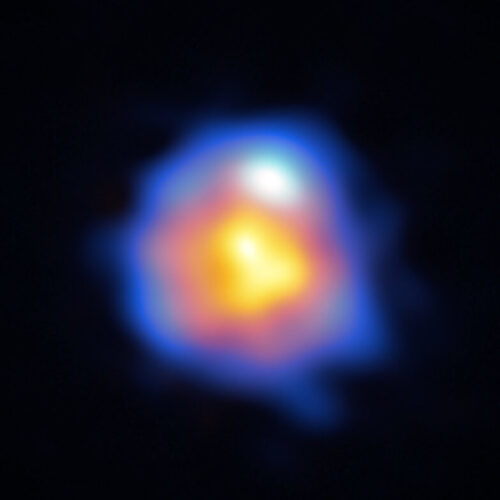
The star R Leporis as seen by the ALMA radio telescope

An article published in “The Astrophysical Journal” reports the results of observations of the star R Leporis conducted using the ALMA radio telescope with its receivers at their highest frequencies and an antenna array configuration spread over an area with a diameter of 16 kilometers. R Leporis, or simply R Lep, is a so-called carbon star, a red giant whose atmosphere is particularly rich in carbon in a phase in which oxygen is normally in greater quantities. Unprecedented observations made it possible to detect details of a natural maser around a star that is reaching the end of its life.

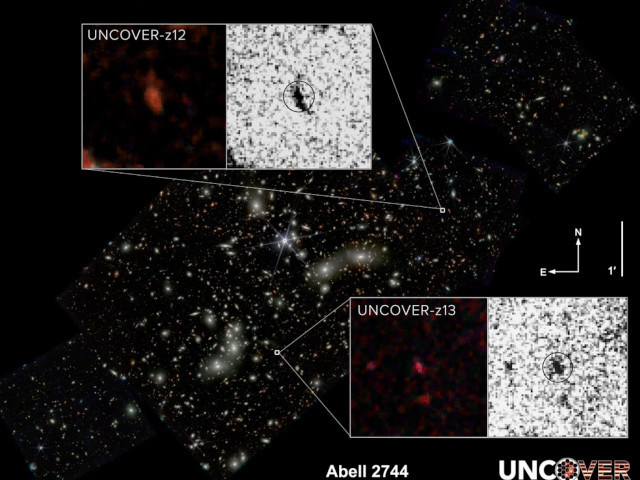
The galaxy cluster Abell 2744 and in the insets the galaxies UNCOVER z-13 and UNCOVER z-12.

An article published in “The Astrophysical Journal Letters” reports confirmations of two primordial galaxies studied within the UNCOVER survey. A team of researchers examined spectroscopic detections obtained by the James Webb Space Telescope’s NIRSpec instrument to obtain good estimates of the distance to the galaxies UNCOVER z-13 and UNCOVER z-12. These are follow-up observations that exploited the gravitational lens generated by the Abell 2744 galaxy cluster. According to the estimates, UNCOVER z-13 is approximately 13.51 billion light-years away while UNCOVER z-12 is approximately 13.48 billion light-years away.

The Perseus galaxy cluster (Image ESA/Euclid/Euclid Consortium/NASA, image processing by J.-C. Cuillandre (CEA Paris-Saclay), G. Anselmi, CC BY-SA 3.0 IGO)

ESA has presented the first official images captured by its Euclid space telescope. After some delays due to problems with the fine guidance sensor, it was possible to calibrate Euclid’s instruments and obtain the extraordinary precision of observations necessary for its mission. The result is a resolution that allows a quantity of detail never seen before to be included in the images, be it galaxies, stars, or other objects, often discovered by Euclid. The presentation showed the results both with distant objects such as the Perseus galaxy cluster and with others close in astronomical terms such as the Horsehead Nebula.