Telescopes

galaxy UHZ1 as seen by the Chandra X-ray Observatory and the James Webb Space Telescope

An article published in the journal “Nature Astronomy”, one published in “The Astrophysical Journal Letters”, and one submitted for publication in “The Astrophysical Journal” report different aspects of the study of the most distant black hole detected at X-rays. Different teams of researchers combined data obtained with the Chandra X-ray Observatory and the James Webb Space Telescope to study the galaxy UHZ1 in X-ray and infrared light. The result is the discovery of a growing supermassive black hole approximately 470 million years after the Big Bang. The study offers evidence that it was born already having considerable mass, confirming that supermassive black holes grow from seeds that form from the direct collapse of enormous amounts of gas.

Artist's concept of the Kepler-385 star system (Image NASA/Daniel Rutter)

An article to be published in “The Journal of Planetary Science” reports updates to the catalog of exoplanet candidates discovered with NASA’s Kepler space telescope which offers confirmation of the presence of seven planets in the Kepler-385 star system. This result was obtained by applying examination methods that were significantly improved compared to the past, obtaining new results from old observations. That includes this system among the very few with over six verified or at least candidate planets, making it particularly interesting. However, all of these planets are closer to their star than the inner edge of that system’s habitable zone and receive a significant amount of energy from it. The consequence is that none of them can be similar to Earth.

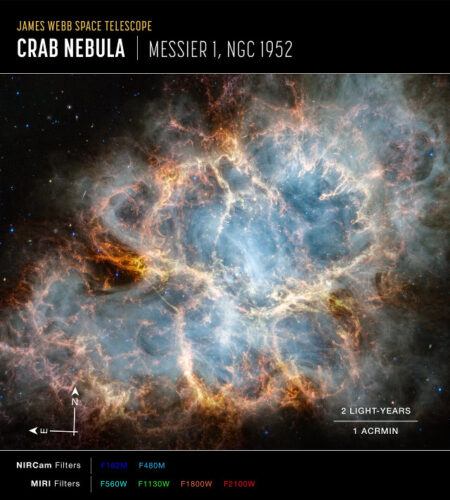
The Crab Nebula as seen by the James Webb Space Telescope

A new image captured by the James Webb Space Telescope depicts the Crab Nebula, the remnants of the supernova spotted on Earth and recorded in 1054, about 6,500 light-years away from Earth. The observation possibilities at the time were limited, to say the least, compared to today’s, so there are still questions regarding that supernova. The NIRCam and MIRI instruments allowed to obtain infrared details showing the synchrotron radiation inside it, produced by the pulsar at its center that formed from the core of the progenitor star that exploded in 1054.

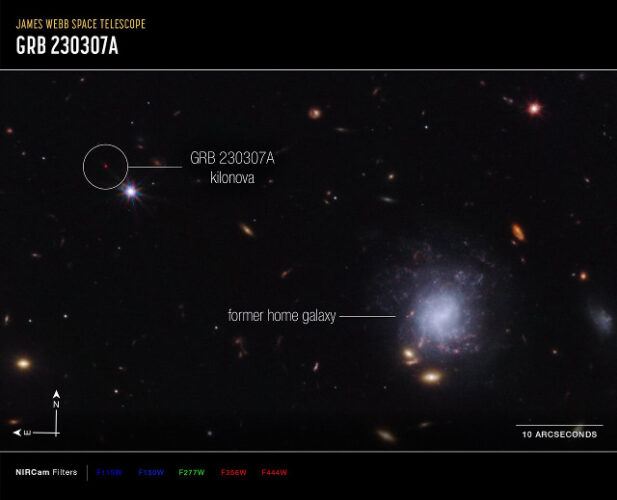
The position of the kilonova that triggered the gamma-ray burst GRB 230307A and the home galaxy from where the progenitor stars arrived.

An article published in the journal “Nature” reports the detection of heavy elements including tellurium ejected from a kilonova, the merger between two neutron stars. A team of researchers started from the gamma-ray burst cataloged as GRB 230307A to examine data collected by ground-based and space telescopes which made it possible to identify the characteristics of a kilonova at the origin of that very powerful explosion, which lasted about 200 seconds in the second brightest gamma-ray burst detected so far.

The James Webb Space Telescope made it possible to examine the environment around the kilonova with its NIRCam and NIRSpec instruments, detecting the spectroscopic traces left in the emissions from materials ejected at high speed. For the first time, tellurium, a very rare element on Earth, was detected. Webb also made it possible to ascertain that the pair of neutron stars that merged was ejected from its home galaxy hundreds of millions of years ago.

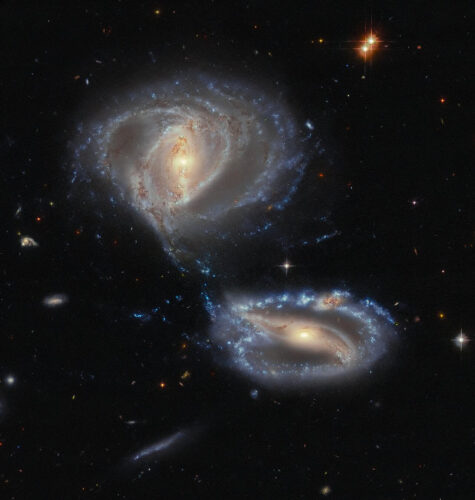
Arp-Madore 2339-661 (Image ESA/Hubble & NASA, J. Dalcanton, Dark Energy Survey/DOE/FNAL/NOIRLab/NSF/AURA Acknowledgement: L. Shatz)

An image captured by the Hubble Space Telescope depicts Arp-Madore 2339-661, an object that until not many years ago was considered a pair of interacting galaxies, cataloged as NGC 7733 (bottom right) and NGC 7734 (top left). However, observing the upper arm of NGC 7733, it’s possible to see a sort of large knot of a color different from the predominant blue which is actually a dwarf galaxy, now cataloged as NGC 7733N. The consequence is that the interaction taking place is what some call a merging group. Mergers between two galaxies are normal but sometimes there are more galaxies and in this case, there are three of them that show signs of having active galactic nuclei.