Telescopes

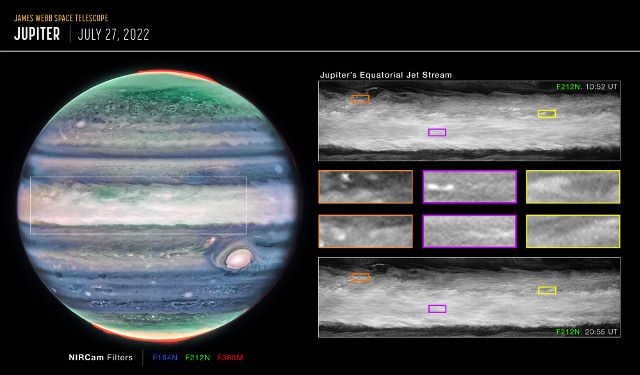
Jupiter in an observation with the NIRCam instrument and in the insets some progressive zooms showing various wind shears at altitudes between 20 and 35 kilometers above in Jupiter's clouds

An article published in the journal “Nature Astronomy” reports the discovery of an equatorial jet stream traveling at over 500 kilometers per hour in the lower layers of the stratosphere of the planet Jupiter extending for almost 5,000 kilometers. A team of researchers analyzed data collected by the James Webb Space Telescope’s NIRCam (Near-Infrared Camera) instrument during observations conducted in July 2022 to obtain details of the winds that include so-called wind shears, sudden variations in intensity and direction with altitude or distance. Data collected with the Hubble Space Telescope provided additional information about the atmosphere of Jupiter’s equator and other phenomena in that area useful in determining the characteristics of the jet stream.

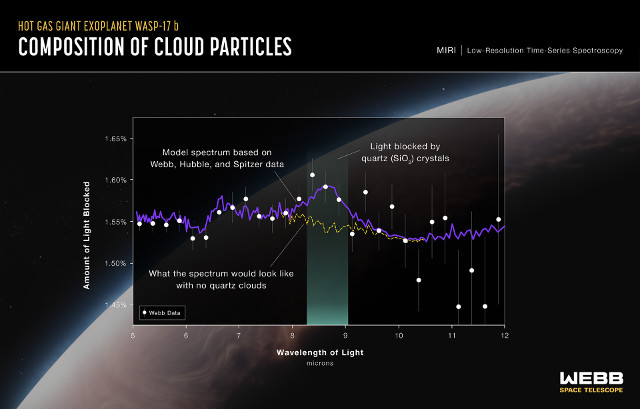
Transmission spectroscopy of the exoplanet WASP-17 b

An article published in “The Astrophysical Journal Letters” reports a study of the exoplanet WASP-17 b that includes the detection of quartz in this hot Jupiter’s atmosphere. A team of researchers used the James Webb Space Telescope to detect the subtle effects of quartz crystals, nanoparticles dispersed in the very hot atmosphere of WASP-17 b, which received the official name Ditsö̀ in early 2020.

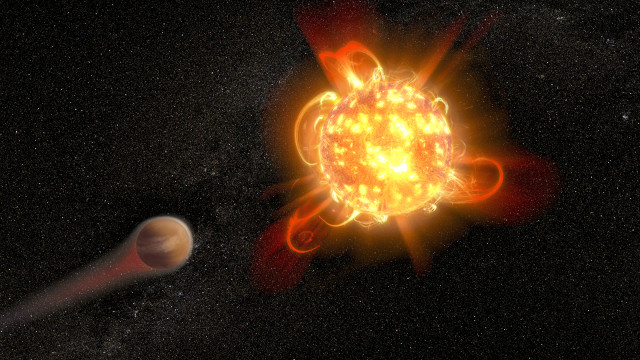
Artistic concept of a red dwarf in a phase of flares that strip the atmosphere from one of its planets (Image NASA, ESA, and D. Player (STScI))

An article accepted for publication in “The Astrophysical Journal” reports the results of spectroscopic observations of the activity of the star TRAPPIST-1 conducted with the James Webb Space Telescope. A team of researchers observed four flares of this ultra-cool dwarf, which occurred over the course of about 27 hours. By adding data obtained with other instruments, it was possible to develop a mathematical method to separate the light of those flares from normal stellar radiation. In the study of a very small but also active star, this is very useful to improve the quality of observations of the seven rocky planets of the TRAPPIST-1 system.

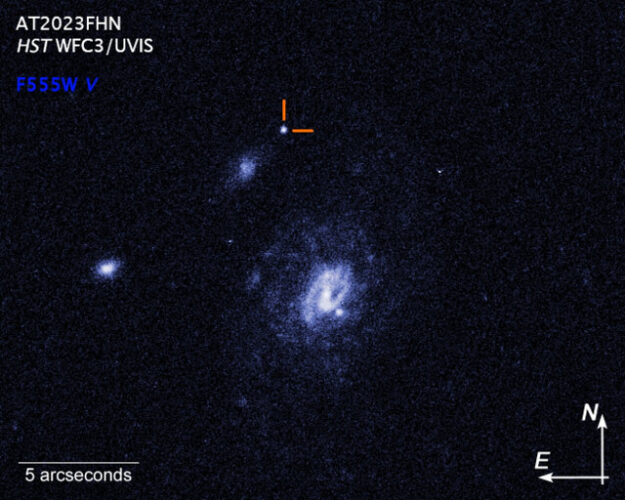
AT2023fhn as seen by Hubble

An article being published in the journal “Monthly Notices of the Royal Astronomical Society” reports the observation of a Luminous Fast Blue Optical Transient (LFBOT), a rare type of cosmic explosion of still uncertain nature which was cataloged as AT2023fhn. A team of researchers used various telescopes to try to study one of the few phenomena of this type known so far but this brought more questions than answers because its origin was found far from any galaxy.

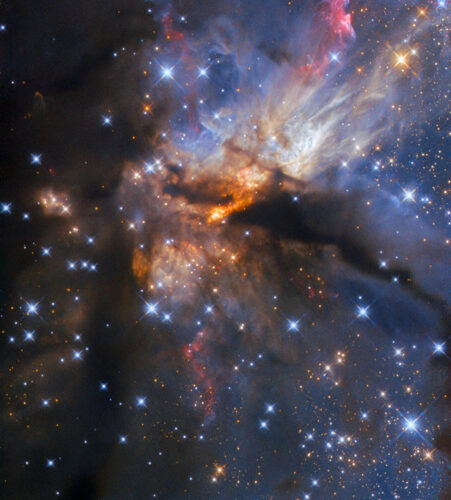
The G35.2-0.7N region (Image ESA/Hubble & NASA, R. Fedriani, J. Tan)

An image captured by the Hubble Space Telescope depicts the star-forming region cataloged as G35.2-0.7N, in which massive stars form. Protostars are surrounded by cocoons of gas and dust which in turn are inside larger clouds, and that usually makes them invisible. However, one of those protostars near the center of the image is emitting jets of materials that illuminate the region and dig into the gas, allowing some of the protostellar light to escape.

About 7,200 light-years away from Earth, the G35.2-0.7N region is of interest to astronomers who are studying the processes that lead to the birth of stars. The Hubble Space Telescope’s Wide Field Camera 3 (WFC3) instrument is one of many that have been used over time in various studies taking photos that have now been assembled into a single image.