
Telescopes

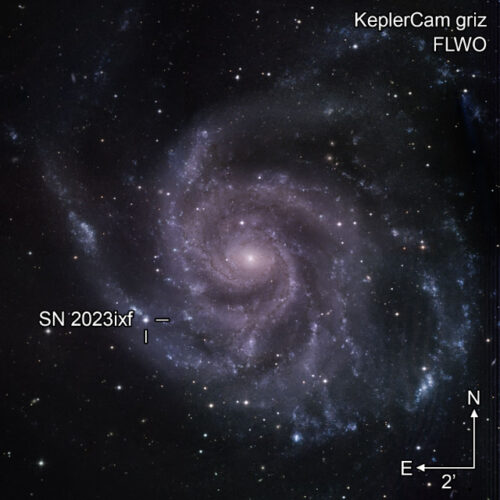
An image of the Pinwheel Galaxy with the location of supernova 2023ixf captured on June 27, 2023, using various optical and infrared frequency filters

Two articles published in “The Astrophysical Journal Letters” report as many studies on the supernova cataloged as SN 2023ixf. Two teams of researchers with members in common examined the evolution of this supernova discovered in the so-called Pinwheel Galaxy. To do this, they used various instruments including some from the Center for Astrophysics (CFA) Harvard & Smithsonian which allowed observations in different electromagnetic bands. The results were different from what was expected from the explosion of a massive star with a delay in the time of the peak of the light pulse just before the explosion. The conclusion is that this was due to the presence of dense materials ejected from the star in the year preceding the supernova.

Artist's illustration of the exoplanet Tahay / GJ 367 b (Image NASA)

An article published in “The Astrophysical Journal Letters” reports a study on the exoplanet GJ 367 b, or Gliese 367 b, formally known by the name Tahay, which concludes that its core is composed almost entirely of iron for a density that is almost twice the Earth’s. The researchers also announced the discovery of two more planets in the system of the star GJ 367, formally known as Añañuca, which may be super-Earths.

Just over 30 light-years from Earth, Añañuca is a red dwarf with a mass and size just under half of the Sun’s. Observations began in 2019 with NASA’s TESS space telescope and in 2021 the data collected led to the exploration of the possibility that a planet orbited very close to this star, subsequently confirmed with other instruments. Tahay’s roughly 7.7-hour year is the shortest in the cosmic neighborhood, one reason for interest and worthy of its own name.

Arp 107 (Image ESA/Hubble & NASA, J. Dalcanton)

An image captured by the Hubble Space Telescope shows Arp 107, a pair of interacting galaxies heading towards a collision. The two galaxies, the spiral galaxy UGC 5984 (or PGC 32620) and the elliptical galaxy MCG +05-26-025 (or PGC 32628), will finish this process in a merger. UGC 5984 is a Seyfert galaxy, a class characterized by an active galactic nucleus that doesn’t block the view of the rest of the galaxy and spectral lines that show a strong ionization. The pair represents an interesting case of the early phase of a galaxy merger.

The HIP 81208 system seen by SPHERE

An article published in the journal “Astronomy & Astrophysics” reports the discovery of an object that could be a gas giant planet or a brown dwarf in the HIP 81208 system. A team of researchers analyzed data from the archive of the observations conducted with the SPHERE instrument mounted on the VLT in Chile discovering an object that was cataloged as HIP 81208 Cb orbiting the smaller of the two stars in this binary system. A brown dwarf was discovered around the more massive star together with the smaller and more distant star in an analysis also published some time ago in an article in “Astronomy & Astrophysics”. The new discovery makes HIP 81208 a so-called hierarchical quadruple system, the first of its kind discovered using a direct imaging system.

A diagram illustrating the combined power of the James Webb and Hubble space telescopes in studying Cepheids present in the galaxy NGC 5584 with the NIRCam (Near-Infrared Camera) and WFC3 (Wide Field Camera 3) instruments, respectively

An article accepted for publication in “The Astrophysical Journal” reports the results of calculating the universe’s expansion rate based on the observation of Cepheids with the James Webb Space Telescope. In particular, a team of researchers led by Adam Riess used the NIRCam instrument to observe over 330 cepheids in the galaxies NGC 4258 and NGC 5584. The results are more precise than those obtained in the past with the Hubble Space Telescope but confirm the accuracy of the previous calculation of the universe’s expansion rate. This leaves open the question of the difference in results obtained with different methods.