Telescopes

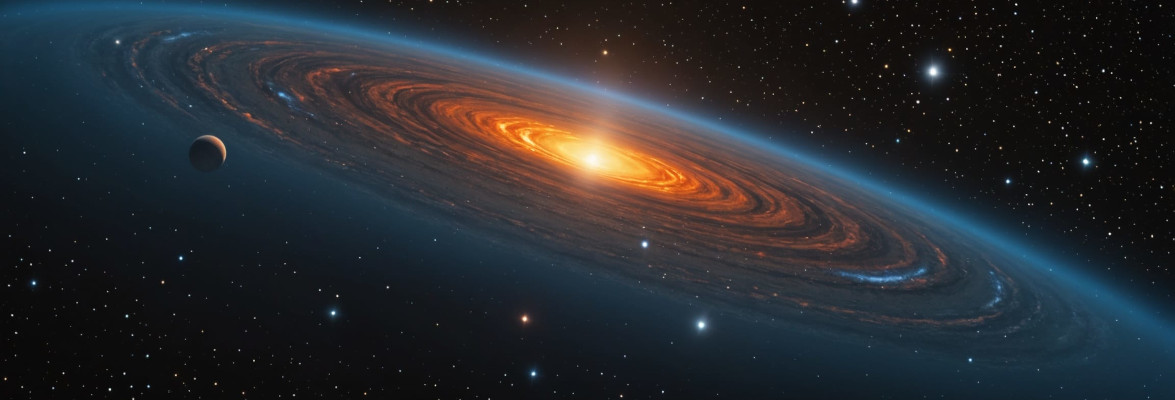
Artist's concept of the TOI-942 system (Image courtesy Italian National Institute of Astrophysics)

An article published in the journal “Astronomy & Astrophysics” reports the identification of two hot Neptunian exoplanets in the TOI-942 system. A team of researchers led by Ilaria Carleo of Wesleyan University, USA, and associated with the Italian National Institute of Astrophysics, Padua, used observations conducted with NASA’s TESS space telescope to find the exoplanet candidates, subsequently confirmed with follow-up observations conducted with the HARPS-N instrument mounted on the Galileo National Telescope, Canary Islands, and the REM instrument at the La Silla observatory, Chile. With an estimated age between 30 and 80 million years, it’s the youngest planetary system discovered thanks to TESS, excellent for studying planet evolution.

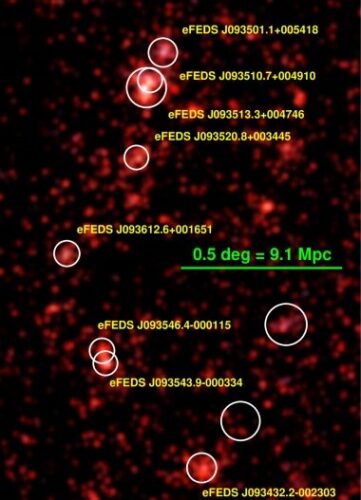
The sky area where the eROSITA instrument identified the eight galaxy clusters that form the new supercluster

An article to be published in the journal “Astronomy & Astrophysics” reports the discovery of a galaxy supercluster. A team of researchers led by Vittorio Ghirardini of the Max Planck Institute for Extraterrestrial Physics in Garching, Germany, analyzed data from the eFEDS survey conducted with the Spektr-RG space telescope’s eROSITA instrument identifying a structure composed of eight different galaxy clusters. Follow-up observations with the LOFAR and uGMRT radio telescopes made it possible to confirm that it’s a supercluster thanks to the identification of filaments that unite the various galaxies. The possibility of improving our knowledge of the cosmic filament web is one of the reasons why it’s important to find these superclusters.

A representation of the Milky Way with the 591 high velocity star candidate in the halo (Image courtesy KONG Xiao of NAOC)

An article published in “The Astrophysical Journal Supplement Series” reports the discovery of 591 high velocity star candidates in the Milky Way’s halo. A team of researchers used data from the Data Release 7 of the Large Sky Area Multi-Object Fiber Spectroscopic Telescope (LAMOST) and the Data Release 2 of the Gaia space probe to find these stars whose velocity is very high compared to the average of the Milky Way stars. The data indicates that 43 of these stars may have enough velocity to escape the galaxy’s gravity.

The galaxy NGC 2217 seen by the Hubble Space Telescope (Image ESA/Hubble & NASA, J. Dalcanton. Acknowledgement: Judy Schmidt (Geckzilla))

A new image captured by the Hubble Space Telescope shows the galaxy NGC 2217, a barred spiral galaxy that we see almost face-on from Earth, a situation that allows astronomers to study its structure with various instruments to try to understand its evolution. The bar passing through its center is quite faint in this galaxy, but astronomers think it’s important to funnel gas from the galactic disk to its center, where it could form new stars or be devoured by the central supermassive black hole.

The blazar PSO J0309+27 (Image Spingola et al.; Bill Saxton, NRAO/AUI/NSF.)

An article published in the journal “Astronomy & Astrophysics” reports a study on the blazar PSO J030947.49+271757.31, or simply PSO J0309+27, the farthest ever identified being about 12.8 billion light-years from Earth. A team of researchers led by astrophysics Cristiana Spingola of the University of Bologna and associated with the Italian National Institute of Astrophysics used the VLBA radio telescope to study PSO J0309+27, discovering details in a jet of materials ejected at about three quarters of the speed of light that spans about 1,600 light-years.