Telescopes

Composed image of Abell 3391/95

An article published in the journal “Astronomy & Astrophysics” reports the discovery of a filamentary structure of hot gas connecting two galaxy clusters about 50 million light-years long. A team of researchers used data collected by the eROSITA instrument, the ASKAP radio telescope, and the DECam instrument to study a system of three galaxy clusters called Abell 3391/95 and found what is the longest filament ever discovered. Its estimated mass confirms that the so-called missing baryon matter could be in those filaments.

GAL-CLUS-022058s, the Molten Ring (Image ESA/Hubble & NASA, S. Jha. Acknowledgement: L. Shatz)

The Hubble Space Telescope has captured an image of GAL-CLUS-022058s, the largest and one of the most complete Einstein rings ever discovered. This type of structure’s name comes from the fact that it was theorized by Albert Einstein in his theory of general relativity. It’s in fact the result of a gravitational lensing effect, which distorts the image of an object behind a galaxy or a galaxy cluster. In this case, the ring’s “liquid” look and the fact that it was identified in the constellation of Fornax, the Furnace, led to the nickname of “Molten Ring”.

The eROSITA bubbles

An article published in the journal “Nature” reports the discovery of a gigantic structure formed by hot gas with a shape similar to that of an hourglass with lobes that extend from the center of the Milky Way. A team of researchers used observations conducted with eROSITA, one of the instruments of the Spektr-RG space telescope, which identified this structure at X-rays that is very similar to the so-called Fermi bubbles.

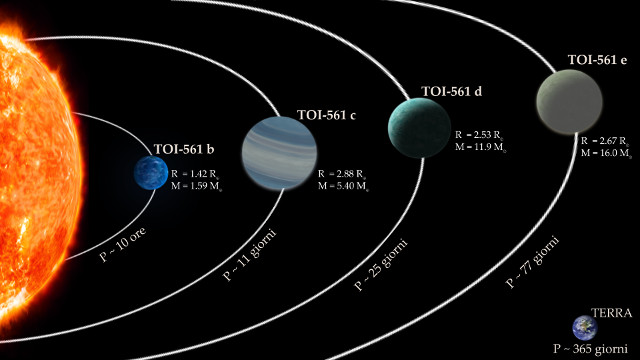
The TOI-561 system

An article published in the journal “Monthly Notices of the Royal Astronomical Society” reports a study on the planetary system of the star TOI-561, which includes a super-Earth and three mini-Neptune. A team of researchers used data from NASA’s TESS space telescope and follow-up research with the HARPS-N spectrograph mounted on the Galileo National Telescope (TNG) on the Canary Island of La Palma to distinguish the traces of the planets and to measure some of their characteristics.

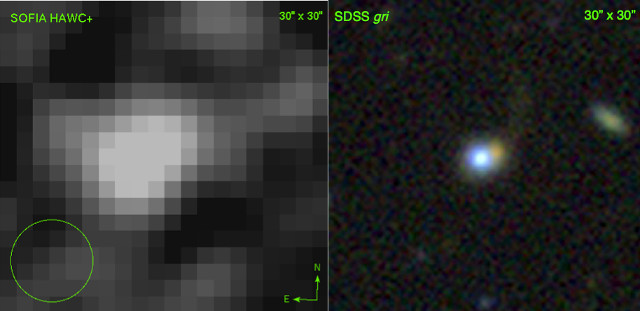
Views of galaxy CQ 4479

An article published in “The Astrophysical Journal” reports a study on the galaxy CQ 4479, where a quasar was observed, an active galactic nucleus with a supermassive black hole that is devouring large amounts of matter, and at the same time an intense star formation. A team of researchers used the SOFIA flying telescope to observe CQ 4479, and found this situation called a cold quasar because the active galactic nucleus is very hot but the galaxy also contains cold gas that gives birth to new stars. This is a rare case that could show an astronomically short period in the evolution of a galaxy before the quasar starts inhibiting star formation.