Telescopes

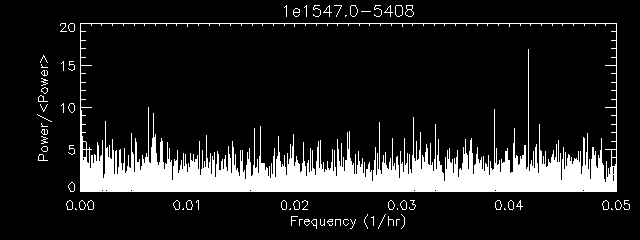
Emissions from 1e1547.0-5408

An article accepted for publication in “The Astrophysical Journal” reports a new analysis of observations conducted in 2009 of the magnetar cataloged as 1E1547.0-5408. A team of researchers led by GianLuca Israel of the Italian National Institute of Astrophysics in Rome used data collected by the Parkes radio telescope and NASA’s Chandra and ESA’s XMM-Newton X-ray space observatories to search for emissions from 1E1547.0-5408. The result was the discovery of strong close emissions of X-rays and radio waves that confirm a link between magnetars and fast radio bursts, the focus of recent research.

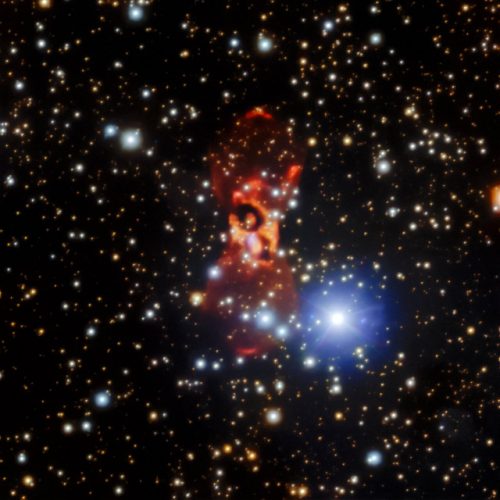
CK Vulpeculae seen with Gemini North (Image International Gemini Observatory/NOIRLab/NSF/AURA. Image processing: Travis Rector (University of Alaska Anchorage), Jen Miller (Gemini Observatory/NSF's NOIRLab), Mahdi Zamani & Davide de Martin)

An article to be published in the “Astrophysical Journal Letters” reports a research on CK Vulpeculae (CK Vul), what was considered a well documented nova having been described between 1670 and 1672, also for the bipolar nebula that left and was recently studied. A team of astronomers led by Dipankar Banerjee, Tom Geballe, and Nye Evans used the GNIRS spectrograph mounted on the Gemini North telescope to obtain measurements that led to the conclusion that CK Vulpeculae is about 10,000 light-years away from Earth, five times as far as previously estimated, and that the explosion was more powerful than a nova but not at the levels of a supernova.

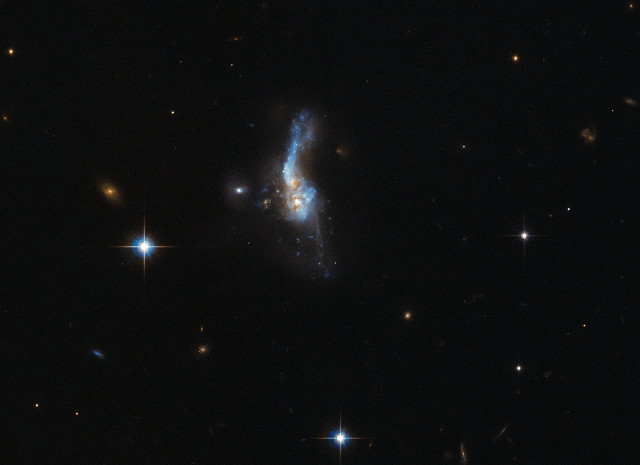
A hyperluminous galaxy seen by Hubble (Image ESA/Hubble)

An article published in the journal “Astronomy & Astrophysics” reports a study on hyperluminous galaxies. A team of researchers led by Lingyu Wang of the Netherlands Institute for Space Research, Utrecht, used the LOFAR radio telescope to assess the amount of hyperluminous galaxies in infrared and concluded that it’s ten times higher than what stars can produce according to current models. If the models are correct, it means that in many galaxies there are other light sources such as an active galactic nucleus powered by a supermassive black hole surrounded by large amounts of materials heated to the point of generating electromagnetic emissions.

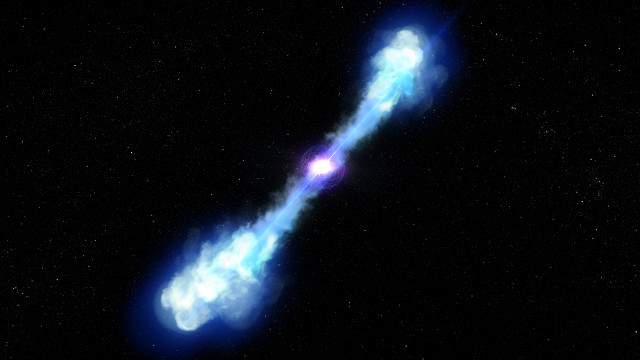
An artistic illustration of a short gamma-ray burst such as GRB 200522A

An article published in “The Astrophysical Journal” reports a study on the kilonova observed on May 22, 2020, and its consequences. It was the merger between two neutron stars that generated a short gamma-ray burst cataloged as GRB 200522A and as a result, produced what from the first analyzes appears to be a magnetar, still a neutron star but of the type characterized by an extremely powerful magnetic field. A team of researchers led by astronomer Wen-fai Fong of Northwestern University in Evanston, Illinois, USA, considered various possible explanations for the observed event, which had an exceptional brightness, and a kilonova that produced a magnetar was the most likely explanation.

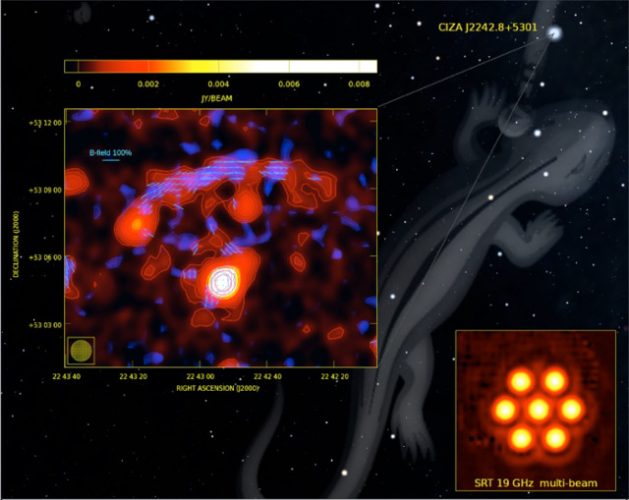
The radio relice in the galaxy cluster CIZA J2242.8+5301

An article published in the journal “Monthly Notices of the Royal Astronomical Society” reports a study on the galaxy cluster CIZA J2242.8+5301. A team of researchers led by astrophysicist Francesca Loi of the Italian National Institute of Astrophysics, Cagliari, used the Sardinia Radio Telescope (SRT) to conduct 240 hours of observations to obtain the highest-frequency spectro-polarimetric image ever produced by a radio telescope of what in jargon is called a radio relic. The quality of the observations enabled to obtain better results than previous studies, which were contradictory, leading to controversy.