Telescopes

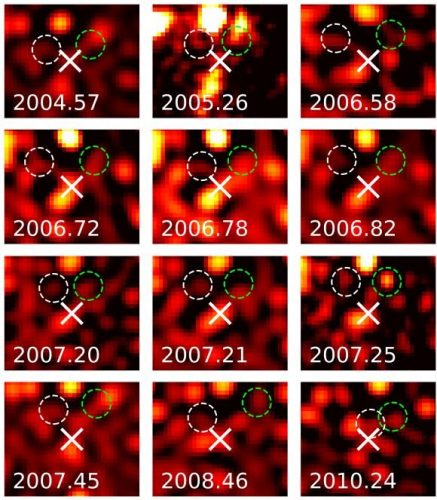
The star S4711 (Image courtesy Florian Peißker et al.)

Two articles published in “The Astrophysical Journal” report research on stars orbiting Sagittarius A*, or simply Sgr A*, the supermassive black hole at the center of the Milky Way, including the ones that reach the highest speed, S62 and S4714, and the one that goes through the orbit in the shortest time, S4711 in 7.6 Earth years. A team of researchers from the German University of Cologne led by Florian Peißker used observations made with the NACO and SINFONI instruments mounted on ESO’s VLT in Chile to track S62’s orbit. With the addition of two more researchers, the team also tracked the orbits of other stars in that area.

Betelgeuse seen by Hubble (Image Andrea Dupree (Harvard-Smithsonian CfA), Ronald Gilliland (STScI), NASA and ESA)

An article published in “The Astrophysical Journal” reports a study on the star Betelgeuse’s dimming that occurred between the end of 2019 and the first quarter of 2020 that had suggested that its supernova explosion was imminent. A team of researchers led by Andrea Dupree of the Center for Astrophysics at Harvard and Smithsonian used the Hubble Space Telescope with ultraviolet observations to find traces of a gigantic mass of hot plasma that rose from Betelgeuse’s surface. That plasma moved away, cooling and turning into dust that covered the star’s surface, reducing its brightness to a third of normal.

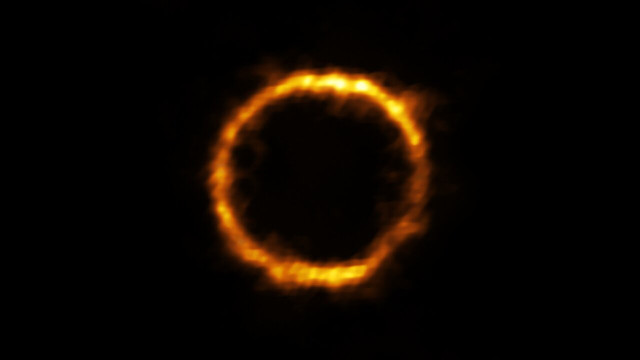
The galaxy SPT0418-47 (Image ALMA (ESO/NAOJ/NRAO), Rizzo et al.)

An article published in the journal “Nature” reports the study of a primordial galaxy we see as it was when the universe was 1.4 billion years old and resembles the Milky Way, a surprise because we see it when it was very young, and according to current theories should be turbulent and unstable. A team of researchers led by Francesca Rizzo, a Ph.D. student at the Max Planck Institute for Astrophysics in Germany, used the ALMA radio telescope to observe this galaxy, cataloged as SPT-S J041839-4751.9, or simply SPT0418-47. Help came from a gravitational lens that magnified the image, allowing to see the similarities with the Milky Way and gather new information on the early stages of galaxy evolution.

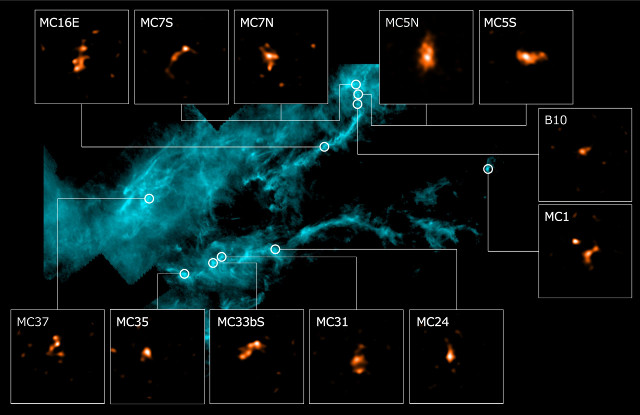
The stellar eggs seen by ALMA

Two articles, one published in “The Astrophysical Journal” and one in “The Astrophysical Journal Letters”, report a census of what were called stellar embryos in the Taurus Molecular Cloud. A team of researchers used the ALMA radio telescope to observe 32 prestellar objects and 7 protostars that offer new insights into the processes leading to the birth of stars. One of the articles focuses on the discovery of a bipolar outflow formed by a pair of gas streams that could be clues to the birth of a star.

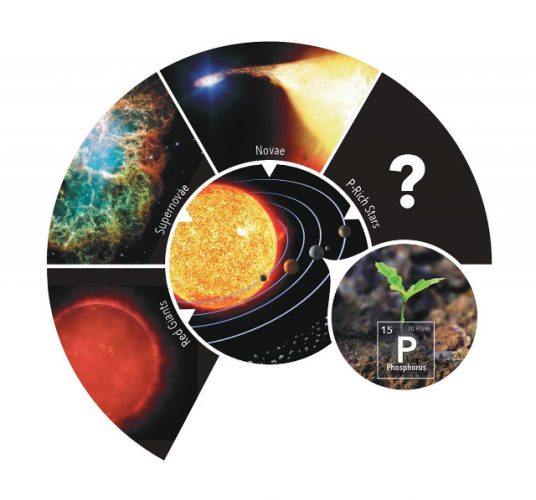
The possible origin of phosphorus

An article published in the journal “Nature Communications” reports the discovery of 15 stars that contain an unusual amount of phosphorus but also of other elements such as magnesium, silicon, oxygen, aluminum, and cerium, an anomaly that suggests a new type of object. A team of researchers led by Thomas Masseron of the Instituto de Astrofísica de Canarias (IAC) examined a large number of infrared spectra obtained during the Sloan Digital Sky Survey together with the optical spectrum of the brightest of the phosphorus stars obtained using the Echelle spectrograph installed at the Nordic Optical Telescope. The possible explanations will have to be tested, but this discovery explains the abundance in the Milky Way of phosphorus, an indispensable element for Earth’s life forms.