Telescopes

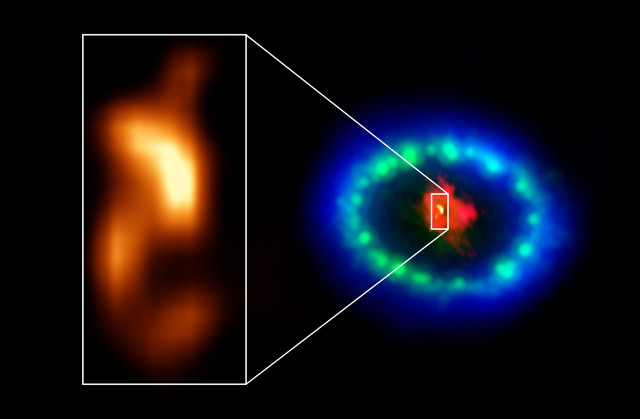
Extremely high-resolution ALMA images revealed a hot “blob” in the dusty core of Supernova 1987A (inset), which could be the location of the missing neutron star

Two articles published in “The Astrophysical Journal” reports two studies on the supernova SN 1987A remnants. Two teams of researchers led by Phil Cigan of the British University of Cardiff and Dany Page of the National Autonomous University of Mexico respectively used observations conducted with the ALMA radio telescope and follow-up theoretical studies to bring evidence that a neutron star formed after the supernova. If these results are confirmed, it would be the youngest known neutron star.

The area around the Per-emb-2 (IRAS 03292+3039) system, indicated by the box

An article published in the journal “Nature Astronomy” reports the first observation of a pair of protostars in the Perseus molecular cloud fed by a flow of gas and various compounds that formed in the parent cloud. A team of researchers led by Jaime Pineda of the Max Planck Institute for Extraterrestrial Physics (MPE) used the Northern Extended Millimeter Array (NOEMA) to study the protostellar binary system cataloged as Per-emb-2 (IRAS 03292+3039). They called that flow of gas and compounds a streamer tracing its movement from the boundaries of the parent cloud to its core, near the protostars. This also helps to better assess the importance of the local environment on the formation and evolution of disks in the systems in formation from which planets could be born.

The galaxy NGC 4414 (Image University of Oregon)

An article published in “The Astronomical Journal” reports a calculation of the universe expansion rate based on the so-called Tully-Fisher relation, an empirical relationship between the intrinsic brightness of a spiral galaxy and its asymptotic rotation velocity. Professor James Schombert, Stacy McGaugh, and Federico Lelli used the accurate distances of 50 galaxies as a guide to measure the distances of 95 other galaxies and then use those measurements to obtain a measure of the so-called Hubble Constant which has a peak of probability at 75.1 kilometers per second per megaparsec. This measure is very different from those obtained with other methods and, as a consequence, indicates that the universe is approximately 12.6 billion years old compared to approximately 13.8 billion obtained from other research.

Chandra Deep Field-South with the 28 heavily obscured supermassive black holes

An article published in “The Astrophysical Journal” reports the discovery of 28 heavily obscured supermassive black holes. A team led by Erini Lambrides of Johns Hopkins University combined over 80 days of observations of NASA’s Chandra space telescope in the survey known as Chandra Deep Field-South (CDF-S) with the ones of other telescopes that include Hubble and Spitzer to identify active galactic nuclei whose emissions at many wavelengths were blocked by the huge cocoon of materials that surrounds them. The heavily obscured supermassive black holes are among the most sought after because understanding their growth mechanisms helps to understand the evolution of these extreme objects that can have masses even billions of times the Sun’s.

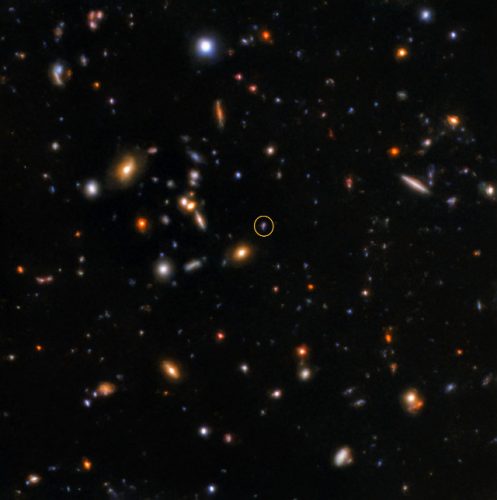
The afterglow of GRB181123B seen by Gemini North (Image courtesy International Gemini Observatory/NOIRLab/NSF/AURA/K. Paterson & W. Fong (Northwestern University))

An article to be published in “The Astrophysical Journal Letters” reports a study of the short gamma-ray burst cataloged as GRB181123B focusing on the discovery of what in jargon is called afterglow, in short, the residues of the emissions of GRB181123B, which in this case were detected at optical frequencies as well. The estimates indicate that that event was generated around ten billion years ago making it the most distant ever detected with an optical afterglow. Probably the cause was a neutron star merger, so events of this type offer information on how long it took for them to occur and their amount at that time.