Landers / Rovers

Blogs about landers and rovers

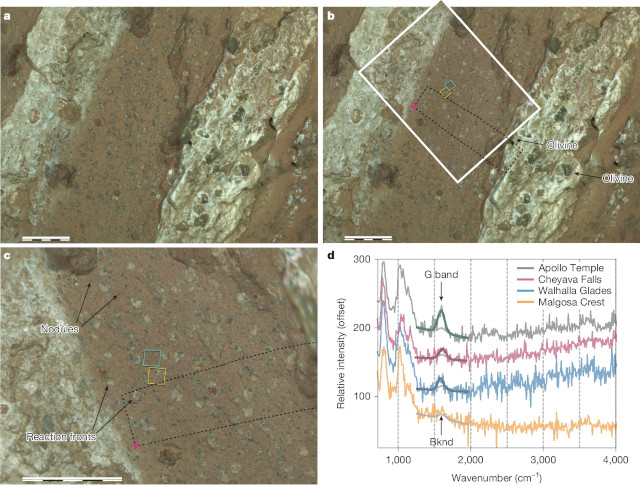
Some views of the rock Cheyava Falls with spectroscopic results (d) from the examination of samples from the area

An article published in the journal “Nature” reports the results of the analysis of data collected by NASA’s Mars Rover Perseverance on the rock nicknamed Cheyava Falls. Perseverance found it in 2024 in the Neretva Valley during its journey within the Jezero Crater on Mars. The rock immediately attracted great interest because it contains chemical signatures and structures that could have been generated by ancient Martian life forms.

A team of researchers confirmed the exciting results presented last year and concluded that these are potential biosignatures. This means they provide clues to the possible presence of Martian life forms in the past, but further studies are needed to obtain definitive answers. In fact, the presence of organic compounds and iron minerals such as vivianite and greigite could also be due to abiotic reactions.

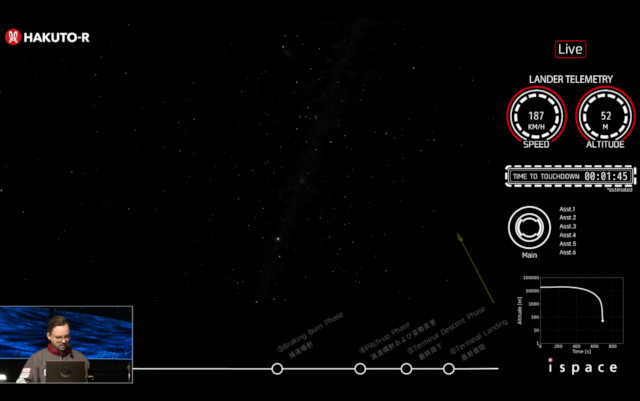
A simulation of the Hakuto-R Resilience lander's trajectory

It was early morning in Tokyo when the Hakuto-R Resilience lander of the Japanese company ispace inc. attempted the Moon landing. For the people who watched the conclusion of the first Hakuto-R lander’s mission, the end of Resilience’s mission unfortunately offered a sense of deja vu. This time, the telemetry transmission was interrupted less than two minutes before the Moon landing, when the speed was measured at 187 km/h at an altitude of 52 meters. This was the so-called Phase 4, during which Resilience was supposed to decelerate. The clear impression is that something went wrong, and this second mission also ended in a crash.

Image captured by Machines’ Nova-C Athena lander during its descent (Image courtesy Intuitive Machines / NASA)

A little while ago, Intuitive Machines’ Nova-C Athena lander attempted its Moon landing in the Mons Mouton area. This was an autonomous maneuver that was the key step in the IM-2 mission. In the minutes following the end of the maneuver, signals started arriving at mission control with increasing clarity. This allowed them to start understanding Athena’s situation.

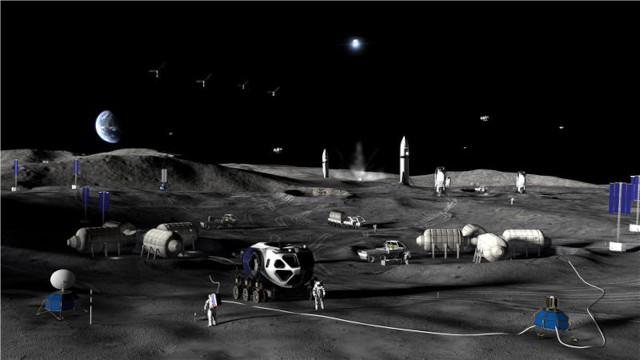
Graphic representation of the Blue Ghost M1 lander on the Moon (Image courtesy NASA / Firefly Aerospace)

A little while ago, Firefly Aerospace’s Blue Ghost lander attempted a Moon landing in Mare Crisium. This was an autonomous maneuver that was the key step in what is known as Mission 1. After completing its braking and touching down on the Moon’s surface, Blue Ghost sent signals from its sensors confirming its success. After just over half an hour, it started sending images of the Moon’s surface.

The Nova-C Athena Moon lander and the Lunar Trailblazer satellite blasting off atop a Falcon 9 rocket (Image courtesy Intuitive Machines)

A few hours ago, the Nova-C Athena Moon lander blasted off atop a SpaceX Falcon 9 rocket from Kennedy Space Center on Intuitive Machines’ IM-2 mission. After about 48 minutes, it successfully separated from the rocket’s last stage and set off on a course to the Moon, where it’s scheduled to attempt a landing on March 6. About 3 minutes later, NASA’s small Lunar Trailblazer satellite also separated from the rocket’s second stage, but its course is very different from Athena’s, so it will not reach the Moon until June.