Launch vehicles

Blog about launch vehicles: rockets or aircraft

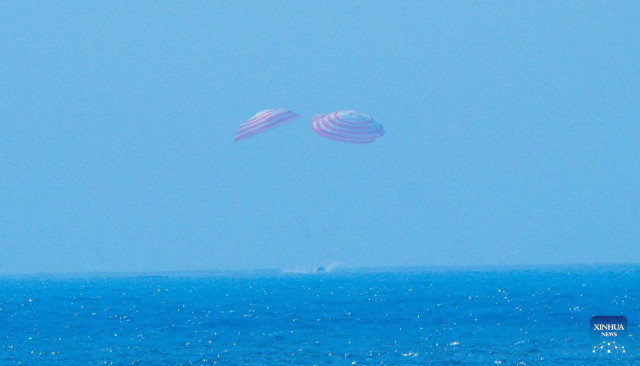
The Menghzou spacecraft splashes down (Photo courtesy of Wang Heng/Xinhua)

Yesterday, the Chinese Menghzou spacecraft, launched on the Long March 10 rocket’s first stage from the Wenchang launch site, completed a suborbital flight test. The rocket conducted its own test, lasting nearly 8 minutes, with a controlled splashdown, as part of the development of a reusable launch system. At the end of the test, the Menghzou splashed down as well, but in its case, it was also recovered, as the capsule is designed to carry taikonauts and is also reusable. These were important tests because their success represents a step forward toward Chinese crewed Moon missions.

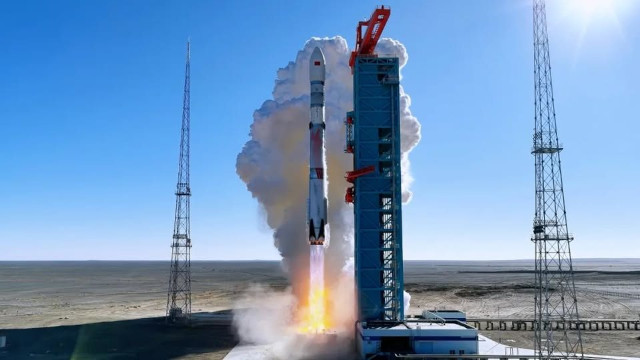
The Zhuque-3 Y1 rocket blasting off (Photo courtesy LandSpace)

A few hours ago, the Chinese Zhuque-3 Y1 rocket blasted off from the Dongfeng commercial space innovation pilot zone, carrying a mass simulator consisting of a prototype of the Haolong cargo spacecraft, currently under development. The second stage successfully reached orbit with payload separation, achieving a successful primary mission upon its debut. LandSpace, the company that developed the rocket, aimed to land the first stage, but this failed due to an anomaly during the reenter maneuvers.

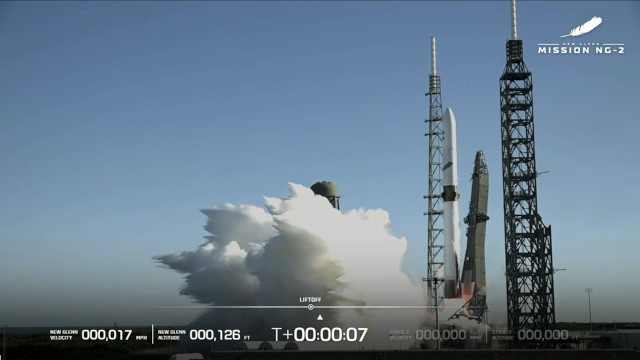
The ESCAPADE twin probes blasting off atop a New Glenn rocket (Image courtesy Blue Origin)

A few hours ago, NASA’s ESCAPADE (Escape and Plasma Acceleration and Dynamics Explorers) twin probes were launched atop a Blue Origin New Glenn rocket, which accomplished its mission, called NG-2. One goal for Blue Origin was to land the first stage, which was a successful one just over 9 minutes after launch. After approximately 33 minutes, the probes, named Blue and Gold, separated from the rocket’s second stage and began a long journey to Mars to study its magnetosphere and the Sun’s impact on the red planet.

Super Heavy 15 and Starship 38 at liftoff (Image courtesy SpaceX)

It was the afternoon in the USA when SpaceX conducted a new flight test of its Super Heavy rocket and Starship prototypes, launched from its base in Boca Chica, Texas. This is the 11th test involving the entire system of Elon Musk’s company, which is supposed to revolutionize space travel with an unprecedented transport capacity and being totally reusable. They are advanced prototypes with the Super Heavy identified as Booster 15, at its second flight, and the Starship Block 2 identified as Starship 38 or Ship38 or simply S38.

Super Heavy Booster 16 and Starship 37 at liftoff (Image: SpaceX)

It was the afternoon in the USA when SpaceX conducted a new flight test of its Super Heavy rocket and Starship prototypes, launched from its base in Boca Chica, Texas. This is the 10th test involving the entire system of Elon Musk’s company, which is supposed to revolutionize space travel with an unprecedented transport capacity and being totally reusable. They are advanced prototypes with the Super Heavy identified as Booster 16 and the Starship Block 2 identified as Starship 37 or Ship37 or simply S37.