Spacecraft

The Cygnus S.S. Ellison Onizuka cargo spacecraft blasting off atop an Antares rocket (Photo NASA’s Wallops Flight Facility/Jamie Adkins)

A few hours ago, Northrop Grumman’s Cygnus spacecraft blasted off atop an Antares rocket from the Mid-Atlantic Regional Spaceport (MARS), part of NASA’s Wallops Flight Facility (WFF) on Wallops Island. After about nine minutes it successfully separated from the rocket’s last stage went en route to its destination. This is its 16th official mission, called NG-16 or CRS NG-16, to transport supplies to the International Space Station for NASA.

The New Shepard rocket blasting off (Image courtesy Blue Origin)

A little while ago, Blue Origin conducted the first crewed flight, which included owner Jeff Bezos, of its New Shepard rocket. It blasted off from the company’s spaceport in Van Horn, Texas, and after about 3 minutes the spacecraft named “RSS First Step” separated from the rocket and reached an altitude of a little more than 106 kilometers, more than the 100 kilometers of the Kármán Line that officially marks the boundary with space. Both the single-stage rocket and the spacecraft are reusable, so both landed at the end of the flight.

The VSS Unity spaceplane detaching from the mothership White Knight Two (Image courtesy Virgin Galactic)

Yesterday, Virgin Galactic conducted the first crewed flight, with owner Richard Branson also on board, of Virgin Galactic’s SpaceShipTwo spaceplane called VSS Unity. It took off connected to the mothership White Knight Two from Spaceport America in New Mexico and, at an altitude of 15,000 meters, VSS Unity was dropped and its engine took it to an altitude of approximately 86.2 kilometers (almost 283,000 feet), below the 100 kilometers of the Kármán Line that officially marks the border with space but above the 80 kilometers considered by some entities as that borderline.

The Dragon cargo spacecraft leaving the International Space Station to end its CRS-22 mission (Image NASA)

A few hours ago, the SpaceX Dragon spacecraft ended its CRS-22 (Cargo Resupply Service 22) mission for NASA splashing down smoothly in Gulf of Mexico, off the coast of Florida. The Dragon left the International Space Station last Thursday. For SpaceX, this was the second mission of the second contract with NASA to transport resupplies to the Station with the new version of the Dragon cargo spacecraft, which splashes down near the East coast of the USA instead of the Pacific Ocean.

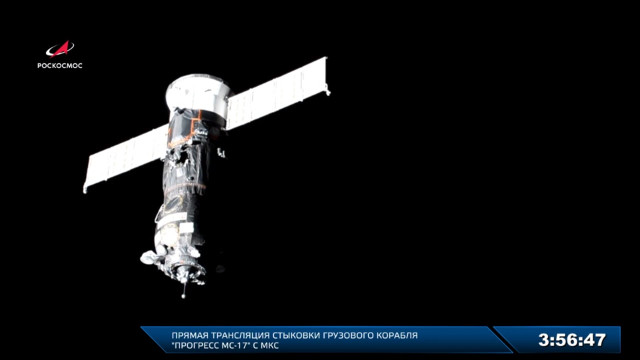
The Progress MS-17 cargo spacecraft approaching the International Space Station (Image courtesy Roscosmos)

A few hours ago, the Progress MS-17 spacecraft docked with the International Space Station in the mission also referred to as Progress 78 or 778. The Russian cargo spacecraft, which blasted off last Tuesday, June 30, carries food, water, scientific experiments, fuel, and various hardware.

The Progress MS-17 cargo spacecraft docked with the International Space Station’s Russian Poisk module. Today, the crew will probably proceed with the hatch opening and the procedures to make the Progress MS-17 an appendage to the Station.