Spacecraft

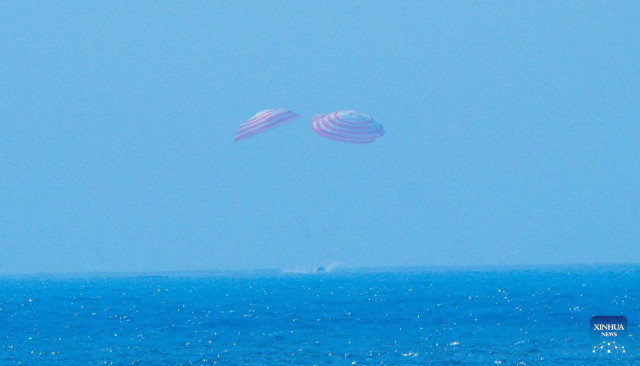
The Menghzou spacecraft splashes down (Photo courtesy of Wang Heng/Xinhua)

Yesterday, the Chinese Menghzou spacecraft, launched on the Long March 10 rocket’s first stage from the Wenchang launch site, completed a suborbital flight test. The rocket conducted its own test, lasting nearly 8 minutes, with a controlled splashdown, as part of the development of a reusable launch system. At the end of the test, the Menghzou splashed down as well, but in its case, it was also recovered, as the capsule is designed to carry taikonauts and is also reusable. These were important tests because their success represents a step forward toward Chinese crewed Moon missions.

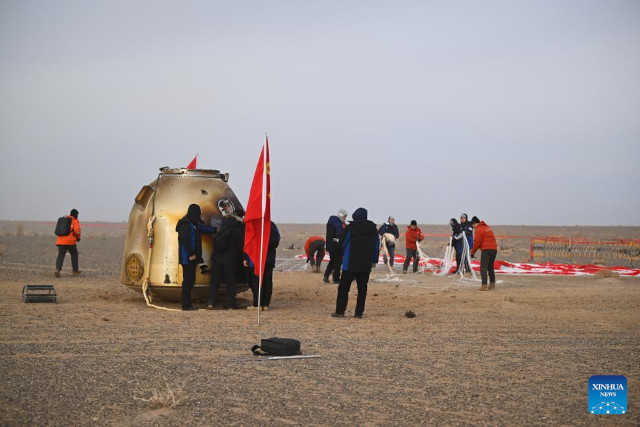
The Shenzhou 20 spacecraft's capsule after landing (Photo courtesy Xinhua/Li Zhipeng)

A few hours ago, the Shenzhou 20 spacecraft landed after spending 270 days docked at the Chinese Tiangong space station, where it arrived on April 24, 2025, carrying three taikonauts: Chen Dong, Chen Zhongrui, and Wang Jie. The Shenzhou 20 departed the station about nine hours earlier and landed at a site called Dongfeng in China’s Inner Mongolia Autonomous Region. The three taikonauts returned to Earth on November 14, 2025, aboard the Shenzhou 21 spacecraft because the Shenzhou 20 suffered small fractures to a window following the impact of what was likely space debris and was deemed unsafe for human transport. Despite this, the preliminary inspection showed that the Shenzhou 20 is generally in good condition.

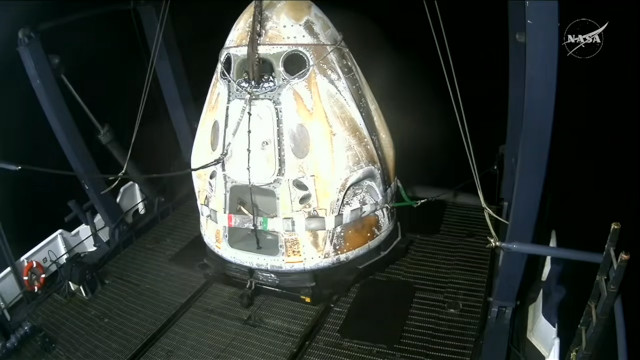
The Crew Dragon Endeavour spacecraft recovered at the end of its Crew-11 mission (Image NASA)

A little while ago, SpaceX’s Crew Dragon Endeavour spacecraft completed its Crew-11, or SpaceX Crew-11, mission for NASA with a successful splashdown. Aboard were astronauts Zena Cardman, Michael Fincke, and Kimiya Yui, and cosmonaut Oleg Platonov, who had arrived at the International Space Station on August 2, 2025, as part of Expedition 73/74. The Crew-11 members ended SpaceX’s 11th regular crewed mission in the Pacific Ocean, off the coast of California. The Crew Dragon had left the Station approximately 11 hours earlier.

The Crew-11 mission ended a few weeks early in what was described as a medical evacuation due to a medical condition affecting one of the crew members. For privacy reasons, no details were released, starting from the identity of the person who’s suffering the health issue.

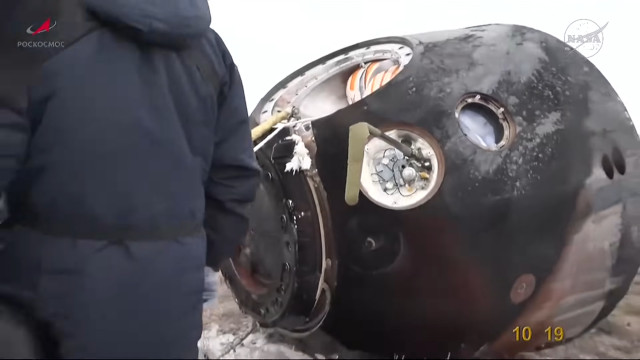
The capsule of the Soyuz MS-27 spacecraft after landing (Image NASA+)

A few hours ago, cosmonauts Sergey Ryzhikov and Alexey Zubritsky and astronaut Jonny Kim returned to Earth on the Soyuz MS-27 spacecraft, which landed in Kazakhstan. They had reached the International Space Station on April 8, 2025, as part of a normal crew rotation. The capsule landed on its side, an event that can occur due to reentry conditions, but the crew members suffered no injuries.

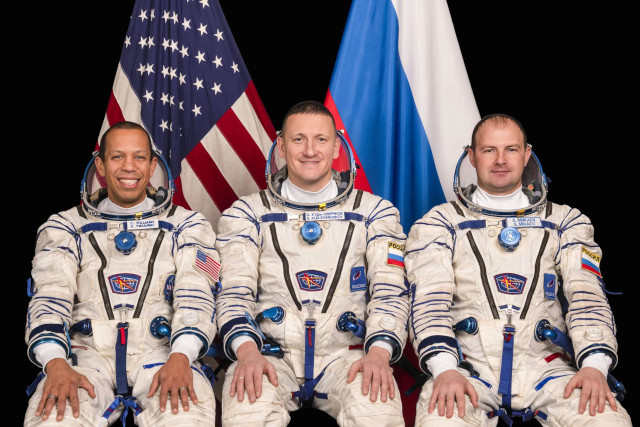
The crew of the Soyuz MS-28 spacecraft: Chris Williams, Sergey Kud-Sverchkov, and Sergey Mikaev (Photo courtesy of GCTC)

A few hours ago, the Soyuz MS-28 spacecraft was launched from the Baikonur Cosmodrome in Kazakhstan and, after a little more than three hours, reached the International Space Station with three new crew members on board. It docked with the Station’s Rassvet module. The ultra-fast track was used, which halves the journey duration and is used whenever the Station’s position makes it possible.