Artist's concept of potentially habitable exoplanets (Image courtesy Christine Daniloff, MIT; iStock)

An article published in the journal “Nature Astronomy” reports a study that examines the possibility of using the measurement of carbon scarcity in the atmosphere of a temperate rocky planet as an indicator of the presence of oceans of liquid water and possible life forms. A team of researchers led by Julien de Wit of MIT and Amaury Triaud of the British University of Birmingham devised a strategy based on the James Webb Space Telescope’s detection capabilities and includes an additional step consisting of the detection of ozone.

The Dragon cargo spacecraft departing the International Space Station to end its CRS-29 mission (Image NASA TV)

A few hours ago, SpaceX’s Dragon spacecraft ended its CRS-29 (Cargo Resupply Service 29) mission for NASA splashing down smoothly off the Florida Coast. The Dragon left the International Space Station a little more than 19 hours earlier. For SpaceX, this was the 9th mission of the 2nd contract with NASA to transport supplies to the Station with the new version of the Dragon cargo spacecraft.

Shortly after the splashdown, SpaceX’s recovery ship went to retrieve the Dragon to transport it to the coast. The cargo brought back to Earth will be delivered to NASA within a few hours. The Dragon spacecraft reached the International Space Station on November 11, 2023.

The Running Chicken with the Moon as a reference as seen from the VST

An image captured by the VLT Survey Telescope (VST) shows a cosmic formation nicknamed the Running Chicken for the shape some see in what is actually a collection of different star-forming regions. The OmegaCAM wide-field camera mounted on the VST generated a 1.5 billion-pixel image that includes never-before-seen detail in an area 25 times the size of the full Moon. The brightest region in the nebula is cataloged as IC 2948 and corresponds to what some see as the chicken’s head and others as its rear end. Towards the center of the image, at a pillar-like structure, there’s a region cataloged as IC 2944. The brightest star is actually closer and is known as Lambda Centauri.

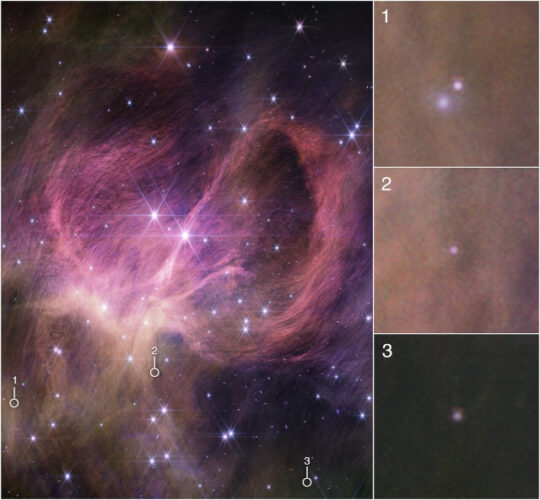
central area of the star-forming area IC 348 seen by the James Webb Space Telescope's NIRCam instrument. Zooms in the insets show the three brown dwarfs discovered in this study.

An article published in “The Astronomical Journal” reports the discovery of three brown dwarfs in the star formation area cataloged as IC 348, part of the large Perseus Cloud. A team of researchers used the James Webb Space Telescope to study that area searching for brown dwarf candidates and identifying three with masses less than eight times Jupiter’s. The smallest of them has a mass estimated between three and four times Jupiter’s, making it the smallest known brown dwarf. Two of them show the chemical signatures of an unidentified aliphatic hydrocarbon whose presence is not predicted by any atmospheric model.

The Cassiopeia A supernova remnant

An image of the Cassiopeia A supernova remnant (NASA, ESA, CSA, STScI, Danny Milisavljevic (Purdue University), Ilse De Looze (UGent), Tea Temim (Princeton University)), or simply Cas A, captured by the James Webb Space Telescope’ NIRCam instrument shows new details of the structures present among the materials surrounding what remains of the progenitor star. In April 2023, images captured by another Webb instrument, MIRI, were published, showing different details of Cassiopeia A. The reasons why certain structures are invisible to NIRCam are also being studied.