Asteroids

IIE iron meteorite sample (Photo courtesy Carl Agee, Institute of Meteoritics, University of New Mexico)

An article published in the journal “Science Advances” reports the results of sophisticated analyzes indicating that IIE iron meteorites are fragments of a planetesimal that had a differentiated structure. A team of researchers conducted various types of tests that gave these results about meteorites called achondrites, composed of materials that were subjected to melting, differentiation, and crystallization. The difference compared to chondrites, meteorites composed of undifferentiated materials, shows that the objects they come from formed and evolved in different ways in space and time.

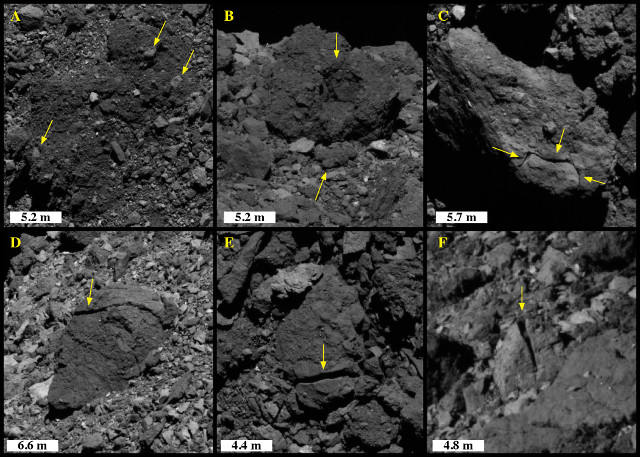
The disaggregation (top row) and linear fractures (bottom row) in rocks on asteroid Bennu

An article published in the journal “Nature Communications” reports the evidence of thermal fractures on asteroid Bennu caused by the temperature difference between day and night. A team of researchers led by Jamie Molaro of the Planetary Science Institute in Tucson, Arizona, examined images of Bennu’s surface captured by NASA’s OSIRIS-REx space probe, and found examples of this phenomenon. It’s the first detection of this phenomenon on an object without an atmosphere, and this offers new information to understand the evolution of Bennu and in general of asteroids over time. That includes the progressive disaggregation of rocks through the particular effect of thermal fracturing called exfoliation.

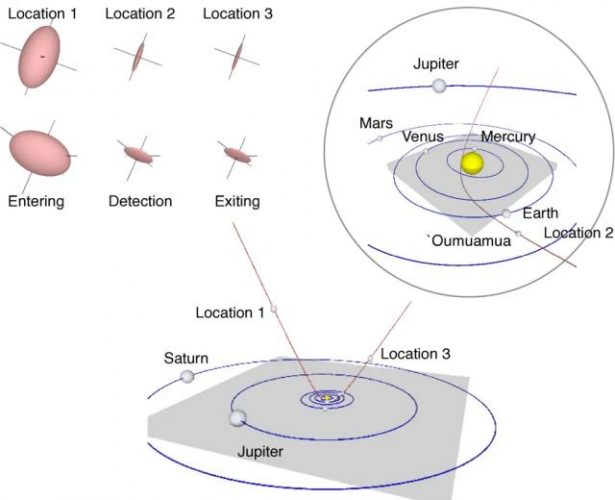
A diagram of the evolution of the interstellar asteroid 'Oumuamua's size and shape

An article accepted for publication in the “Astrophysical Journal Letters” reports a study on the interstellar asteroid 1I/2017 U1 / ‘Oumuamua that offers an explanation for its strange properties. Professor Gregory Laughlin of the University of Yale and Dr. Darryl Seligman of the University of Chicago examined the data collected during the various observations of ‘Oumuamua concluding that it could contain a significant percentage of hydrogen ice and could have originated in the heart of a molecular cloud.

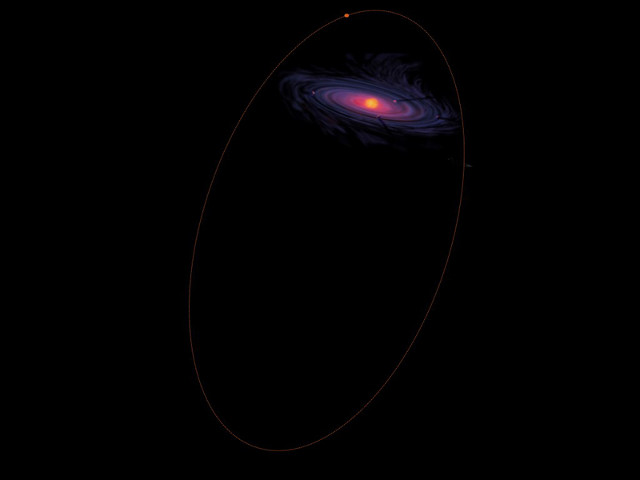
The possible orbit of an interstellar centaur asteroid

An article published in the journal “Monthly Notices of the Royal Astronomical Society” reports evidence of the interstellar origin of some asteroids of the centaur family and two transneptunian objects. Astronomer Fathi Namouni of the University of the Côte d’Azur in Nice, France, and his colleague Helena Morais of the Universidade Estadual Paulista, Brazil, used computer simulations to reconstruct the orbits of those asteroids backwards, concluding that they’re likely interstellar asteroids captured from another system that could have been much closer when the Sun and the stars born with it had just formed.

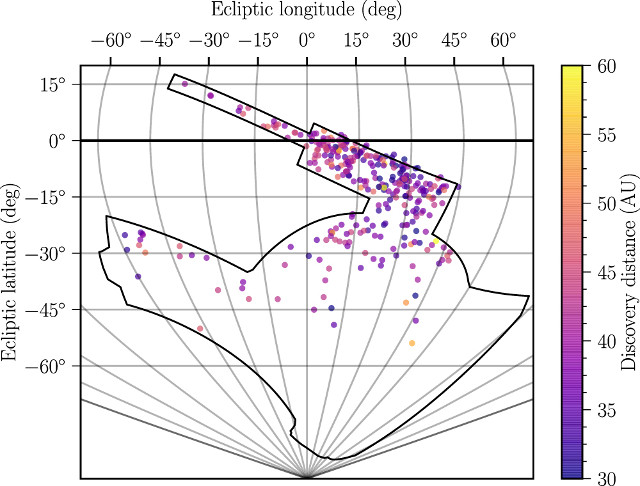
Position and distance diagram of the trans-neptunian objects detected

An article published in “The Astrophysical Journal” presents a catalog of 316 trans-neptunian objects detected by the Dark Energy Survey (DES) during the first four years of operations. A team led by Pedro Bernardinelli analyzed the data collected with a patient work to eliminate the fixed objects and then focused on the transient ones until they obtained the identification of 245 objects already known and 139 that were hitherto unknown. They’re at distances between 30 and more than 90 times the Earth’s from the Sun. Their detection will help to understand their origin and in general the Kuiper belt, where someone thinks that there may be another planet.