Black holes

The double quasars cataloged as J0749+2255 and J0841+4825

An article published in the journal “Nature Astronomy” reports the discovery of two double quasars that could be part of a hidden population because two quasars that are very close are difficult to distinguish. A team of researchers used Hubble Space Telescope observations of quasars to find these pairs dating back to about 10 billion years ago. The two quasars of each pair are about 10,000 light-years apart, and the galaxies that host them will merge and at a certain point the supermassive black holes that power the quasars will merge as well.

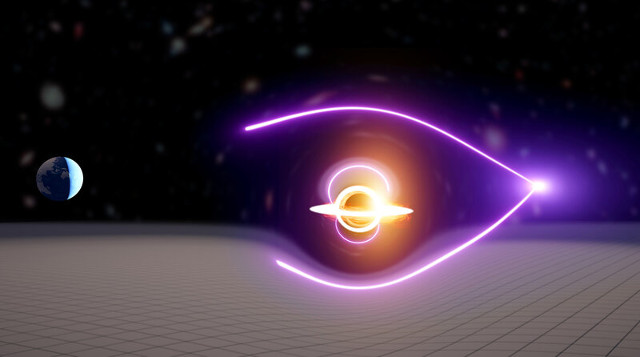
Artistic concept of the candidate intermediate-mass black hole and its deflected gamma-ray burst (Image courtesy Carl Knox, OzGrav)

An article published in the journal “Nature Astronomy” reports the discovery of a candidate intermediate-mass black hole. A team of researchers studied a gravitational lens using detections of photons that were part of a gamma-ray burst to calculate the mass of the lens based on the delay caused by the deviation of the photons of its “echo”. The result is that the mass of the object acting as a gravitational lens was estimated to be about 55,000 times the Sun’s. The nature of the object is not certain but the analysis of the data clearly favors the hypothesis that it’s an intermediate-mass black hole, a type of black hole that is rare and, above all, very elusive.

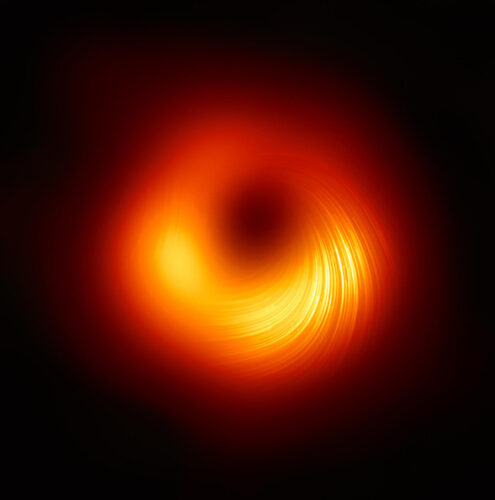
The area around the supermassive black hole of the galaxy M87 in polarized light

Two articles published in “The Astrophysical Journal Letters” report different aspects of a study that led to the representation of the area around the supermassive black hole at the center of the galaxy M87 in polarized light. Scientists from the Event Horizon Telescope Collaboration used data collected in 2017 to obtain a new image that offers new information on the structure of the magnetic fields around the supermassive black hole. A third article published in the same journal reports the details of the observations conducted with the ALMA radio telescope during the 2017 observation campaign.

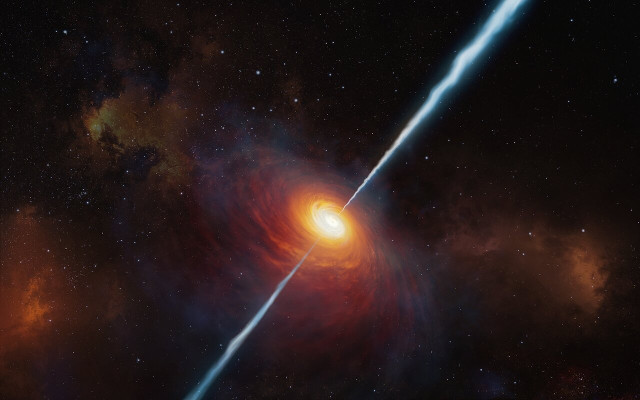
Artist's representation of P172+18 (Image ESO/M. Kornmesser)

An article published in “The Astrophysical Journal” reports the discovery of the farthest radio-loud quasar. A team of researchers led by Chiara Mazzucchelli, a Fellow at ESO in Chile, and Eduardo BaƱados of the Max Planck Institute for Astronomy used various telescopes to identify the quasar cataloged as PSO J172.3556+18.7734 and simply called P172+18. This quasar is about 13 billion years old and that means we see it as it was when the universe was very young, less than 800 million years after the Big Bang. It can offer new insights into the primordial universe and the objects its emissions passed through to reach Earth.

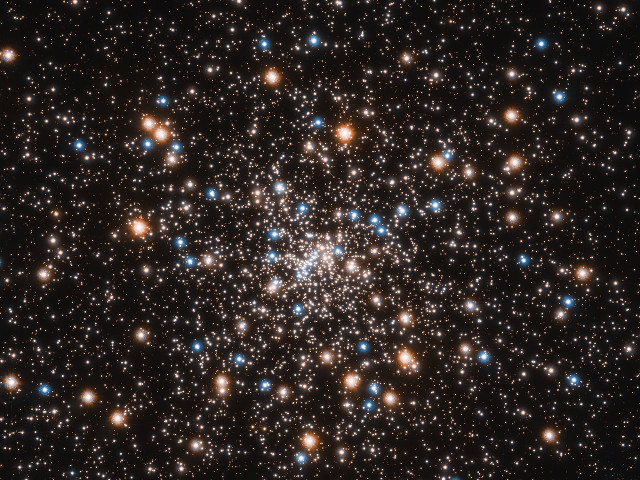
The globular cluster NGC 6397 seen by Hubble (Image NASA, ESA, and T. Brown and S. Casertano (STScI). Acknowledgement: NASA, ESA, and J. Anderson (STScI))

An article published in the journal “Astronomy & Astrophysics” reports evidence of the presence of a group of black holes in the globular cluster NGC 6397. Eduardo Vitral and Gary A. Mamon of the Institut d’Astrophysique de Paris (IAP) used observations conducted with the Hubble Space Telescope and the Gaia space probe to study the core of NGC 6397 expecting to find evidence of the presence of an intermediate-mass black hole that was a hidden mass, but the analyzes of the star movements within the cluster indicated the presence of various stellar-mass black holes.