Black holes

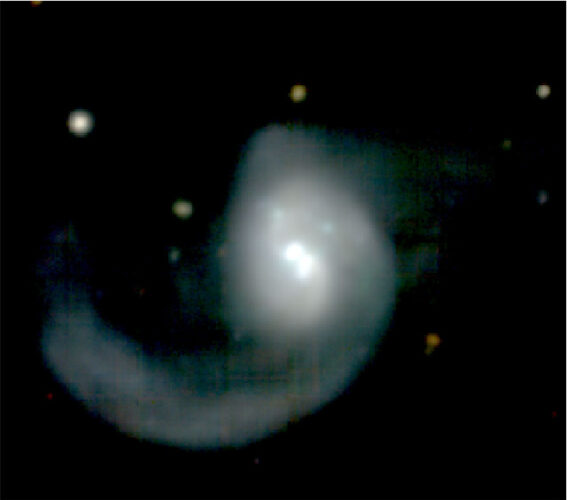
The galaxy ESO 253-G003 seen by the MUSE instrument (Michael Tucker (University of Hawai’i) and the AMUSING survey)

An article under review for publication reports a study on the galaxy ESO 253-G003 that classifies it among the ones with an active galactic nucleus that is consuming a star orbiting the central supermassive black hole. A team of researchers led by Anna Payne of the University of Hawaii used observations conducted with various telescopes to study the phenomenon, cataloged as ASASSN-14ko, detecting a series of regular cosmic outbursts that were interpreted as energy emissions linked to the passage of a star too close to the black hole, which destroys a part of it at each orbit.

The blazar PSO J0309+27 (Image Spingola et al.; Bill Saxton, NRAO/AUI/NSF.)

An article published in the journal “Astronomy & Astrophysics” reports a study on the blazar PSO J030947.49+271757.31, or simply PSO J0309+27, the farthest ever identified being about 12.8 billion light-years from Earth. A team of researchers led by astrophysics Cristiana Spingola of the University of Bologna and associated with the Italian National Institute of Astrophysics used the VLBA radio telescope to study PSO J0309+27, discovering details in a jet of materials ejected at about three quarters of the speed of light that spans about 1,600 light-years.

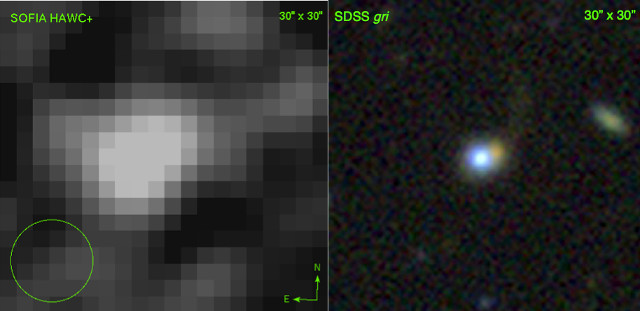
Views of galaxy CQ 4479

An article published in “The Astrophysical Journal” reports a study on the galaxy CQ 4479, where a quasar was observed, an active galactic nucleus with a supermassive black hole that is devouring large amounts of matter, and at the same time an intense star formation. A team of researchers used the SOFIA flying telescope to observe CQ 4479, and found this situation called a cold quasar because the active galactic nucleus is very hot but the galaxy also contains cold gas that gives birth to new stars. This is a rare case that could show an astronomically short period in the evolution of a galaxy before the quasar starts inhibiting star formation.

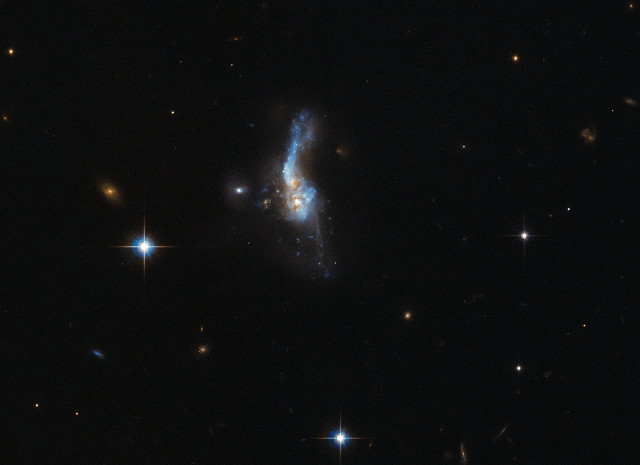
A hyperluminous galaxy seen by Hubble (Image ESA/Hubble)

An article published in the journal “Astronomy & Astrophysics” reports a study on hyperluminous galaxies. A team of researchers led by Lingyu Wang of the Netherlands Institute for Space Research, Utrecht, used the LOFAR radio telescope to assess the amount of hyperluminous galaxies in infrared and concluded that it’s ten times higher than what stars can produce according to current models. If the models are correct, it means that in many galaxies there are other light sources such as an active galactic nucleus powered by a supermassive black hole surrounded by large amounts of materials heated to the point of generating electromagnetic emissions.

Artist's concept of tidal disruption event (Image ESO/M. Kornmesser)

An article published in the journal “Monthly Notices of the Royal Astronomical Society” reports a study on a tidal disruption event cataloged as AT2019qiz in which it was possible to see the phases in which a star was destroyed by a supermassive black hole. A team of researchers led by astrophysicist Matt Nicholl from the British University of Birmingham used various telescopes including ESO’s Very Large Telescope (VLT) and New Technology Telescope (NTT) and NASA’s Spitzer space observatory to follow this event, which lasted about six months, with the star’s “spaghettification” and about half of it swallowed by the black hole.