Black holes

Artistic representation of the newborn black hole which has a distorted shape with a cusp along with the emissions of gravitational waves

An article published in the journal “Communications Physics” reports a study on black hole mergers that shows the relationship between the gravitational signal emitted by that event and the shape of the black hole produced by it. A team of researchers led by Juan Calderón Bustillo – Marie Curie Fellow of the Galician Institute of High Energy Physics in Santiago de Compostela, Spain, created computer simulations of these mergers establishing that the shape of the black hole produced, distorted during the moments while it’s settling and similar to a chestnut, influence the characteristics of gravitational waves. The “chirps”, as the multiple frequency peaks produced in the gravitational emissions, could be detected if the line of sight were parallel to the merger’s orbital plane.

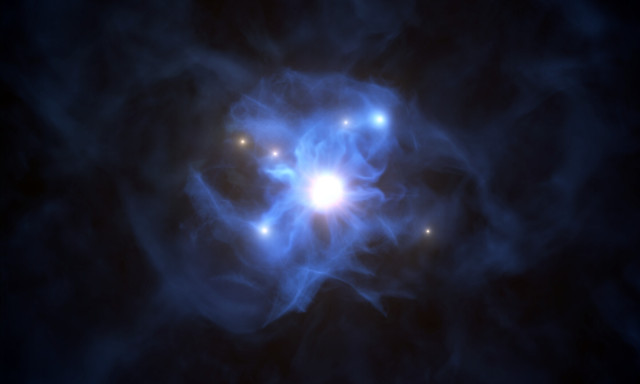
Artist's concept of a supermassive black hole surrounded by galaxies within a cosmic web (Image ESO/L. Calçada)

An article published in the journal “Astronomy & Astrophysics Letters” reports a study on a group of six galaxies surrounding a supermassive black hole which date back to an early epoch when the universe was less than a billion years old. A team of researchers led by Marco Mignoli of the Italian National Institute of Astrophysics (INAF), Bologna, used ESO’s Very Large Telescope (VLT) and the Large Binocular Telescope (LBT) to observe that structure which turned out to be complex as it includes filaments of matter that extend for a distance over 300 times the size of the Milky Way. The gas that concentrates in that structure forms what have been likened to the threads of a spider’s web, and that gas could be responsible for the development of a supermassive black hole in such a remote time.

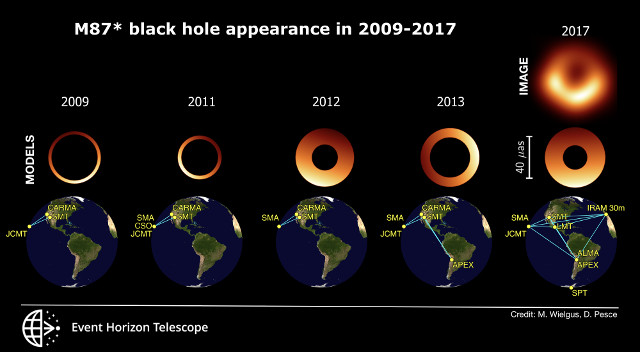
Simulations and observations of M87*

An article published in “The Astrophysical Journal” reports a study on the data collected during the years of the area around the supermassive black hole at the center of the galaxy M87, the one in the image presented in April 2019 by the Event Horizon Telescope project (EHT) project. A team of researchers led by Maciek Wielgus of the Center for Astrophysics | Harvard & Smithsonian (CfA) also analyzed data not published but was part of the observations carried out between 2009 and 2013 with fewer radio telescopes. Those observations were very useful to show the changes in that area, with the shadow of the black hole M87* wobbling and with a variation in its orientation.

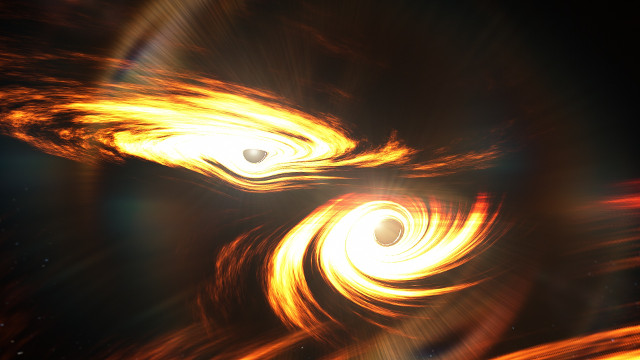
Artistic concept of two black holes that are about to merge (Image courtesy Mark Myers, ARC Centre of Excellence for Gravitational Wave Discovery (OzGrav))

Two articles, one published in the journal “Physical Review Letters” and one in “The Astrophysical Journal Letters”, report various aspects of an analysis of the data collected by the LIGO and Virgo Collaborations on the merger between two black holes of which the gravitational waves have been detected in the event cataloged as GW190521. The two black holes involved had masses out of the ordinary, estimated at 66 and 85 times the Sun’s, for a total mass of about 150-151 times the Sun’s. The black hole produced has a mass estimated at 142 times the Sun’s, which means that about 9 solar masses were turned into energy during that event to form an intermediate-mass black hole, the first observed at its birth.

The galaxy TXS 0128+554 seen by VLBA at various frequencies (Image Lister, et al.; Sophia Dagnello, NRAO/AUI/NSF)

An article published in “The Astrophysical Journal” reports a study of the galaxy TXS 0128+554 and in particular of the jets of particles emitted by the supermassive black hole at its center that form two lobes that appear to have different ages. A team of researchers led by Matthew Lister of Purdue University used the Very Long Baseline Array (VLBA) and NASA’s Chandra X-ray Observatory to observe the jets of materials and gamma-ray emissions. The conclusion is that the jets started about 80 years ago, stopped and then started again about 10 years ago.