Black holes

Artist's concept of the GW190814 event

An article published in “The Astrophysical Journal Letters” reports a study on the origin of gravitational waves detected in the event cataloged as GW190814 on August 14, 2019, in which a black hole with a mass about 23 times the Sun’s merged with an object with a mass about 2.6 times the Sun’s whose nature is uncertain. The scientists of the LIGO and Virgo collaborations analyzed the data collected by the network of interferometers that recorded the gravitational waves emitted by that event. The problem is that the mass of the less massive object is within a gap where it’s not currently possible to say whether a compact object is a neutron star or a black hole.

Artist's concept of two supermassive black holes in a galaxy

An article published in “The Astrophysical Journal” reports a study of over 2,000 active galactic nuclei (AGN) among which some may have two supermassive black holes. A team of researchers led by Pablo PeƱil, a Ph.D. student at Universidad Complutense de Madrid in Spain, analyzed the data collected in nine years of observations from NASA’s Fermi space telescope to identify gamma-ray emissions that repeat every two years and could indicate the interaction of two supermassive black holes. 11 of the galaxies examined have nuclei with this type of emissions while 13 others show hints of that type of emissions and require follow-up observations to verify their nature.

Gamma-ray and X-ray observations of the center of the Milky Way

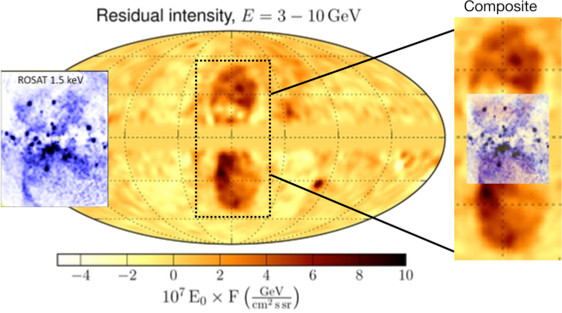
An article published in “The Astrophysical Journal” offers an explanation of the origin of the so-called Fermi bubbles, the two gigantic gas bubbles existing above and below the center of the Milky Way. Guo Fulai and Zhang Ruiyu of the Shanghai Astronomical Observatory (SHAO) of the Chinese Academy of Sciences conducted a series of simulations that allowed to create a model that explains the origin of the Fermi bubbles and at the same time of the biconical X-ray structure at the center of the galaxy. According to the new model, the two phenomena are caused by shock waves generated by two jets from Sagittarius A*, or simply Sgr A*, the supermassive black hole at the center of the Milky Way, around 5 million years ago.

Artist's concept of the HR 6819 system

An article published in the journal “Astronomy & Astrophysics” reports the discovery of a black hole in a triple system known as HR 6819. A team of researchers led by ESO’s Thomas Rivinius used the FEROS spectrograph on the MPG/ESO 2.2 meter telescope at La Silla to examine that system in a study on binary systems, surprisingly discovering the presence of a third object identified as a black hole. It’s the closest black hole to the solar system, but according to the researchers it could be the tip of the iceberg, and there could be many others like that, as predicted by theoretical models.

Artist's concept of the two massive black holes in the OJ 287 galaxy (Image NASA/JPL-Caltech)

An article published in “The Astrophysical Journal Letters” reports observations of a supermassive black hole passing through the disk of materials surrounding another object of the same type but even more massive in the galaxy OJ 287. A team of researchers used NASA’s Spitzer space telescope to monitor this event, which was predicted by a model created specifically to take into account the extreme environment generated in particular by the larger of the two black holes, whose mass is estimated at around 18 billion times the Sun’s. This model, from 2018, is the most recent and takes into account gravitational waves but also the no-hair theorem.