Black holes

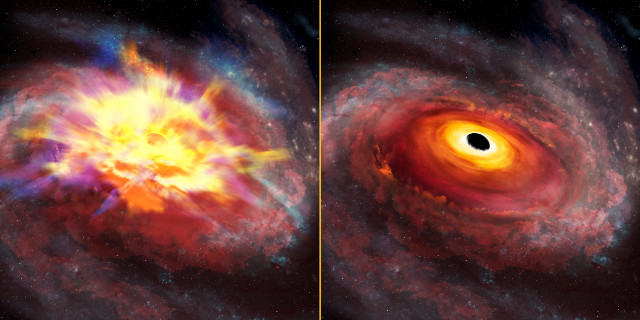
Artistic concept of the quasar SDSS J135246.37+423923.5 and the galaxy that hosts it

An article published in “The Astrophysical Journal” reports the discovery of the most energetic outflow from a distant quasar, to be precise from the one classified as SDSS J135246.37+423923.5. A team of researchers used the Gemini North telescope, Hawaii, to conduct the observations they needed and a new computer modeling system had to be used to interpret what was called an extragalactic storm hidden in plain sight for 15 years. The outflow, a sort of cosmic wind, travels at a speed that is almost 13% of the speed of light with a strong impact on the star formation in the galaxy hosting the quasar.

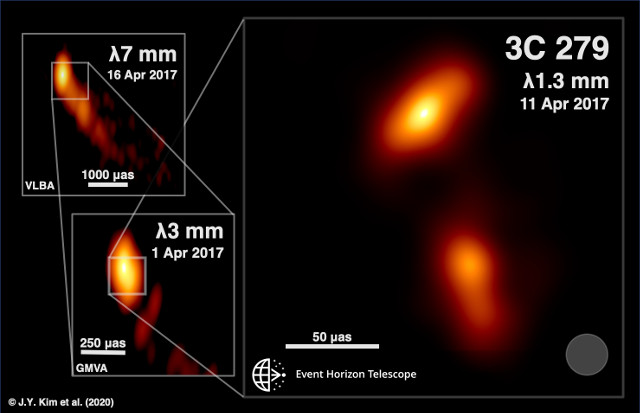
The blazar 3C 279

An article published in the journal “Astronomy & Astrophysics” reports the creation of images of the blazar 3C 279 by the Event Horizon Telescope (EHT) Collaboration. One year after the presentation of the photo of the area around the supermassive black hole at the center of the galaxy Virgo A, also known as M87, the international collaboration that used a series of radio telescopes to obtain the most detailed astronomical image of the history of an object millions of light years away offers the results of another observation campaign. Again, an object of that type was at the center of the attention, but 3C 279 is about a hundred times farther away than Virgo A. Despite this, EHT captured the sharpest details ever obtained of a relativistic jet produced by a supermassive black hole, of which it was also possible to trace the origin.

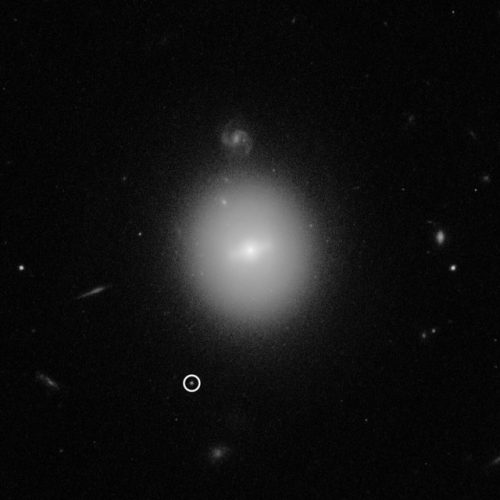
3XMM J215022.4-055108 in the circle (Image NASA, ESA, and D. Lin (University of New Hampshire))

An article published in “The Astrophysical Journal Letters” reports the discovery of the best evidence so far of the existence of intermediate-mass black holes. A team of researchers led by Dacheng Lin of the University of New Hampshire used the Hubble Space Telescope for a follow-up study based on X-ray data collected by other space telescopes that observed the source cataloged as 3XMM J215022.4-055108. The result is that this source is located in a dense star cluster on the periphery of another galaxy and the characteristics indicate that it’s an intermediate-mass black hole with a mass over 50,000 times the Sun’s.

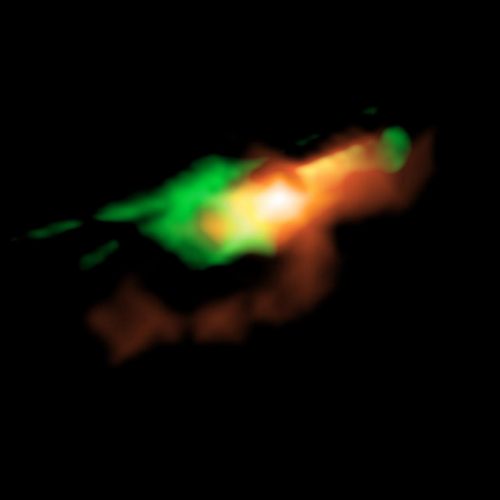
The quasar MG J0414+0534

An article published in “The Astrophysical Journal Letters” reports the observation of jets of energetic particles coming from a supermassive black hole interacting with clouds of gas around them in the quasar MG J0414+0534, about 11 billion light years away. A team of researchers used the ALMA radio telescope to observe that quasar, but its details were detected thanks to a gravitational lensing effect generated by a galaxy between the quasar and the Earth. The interaction between jets and clouds suggests that the quasar’s radio activity is at an early stage and therefore useful to better understand the early stages of evolution of the galaxies that host a quasar in the early universe.

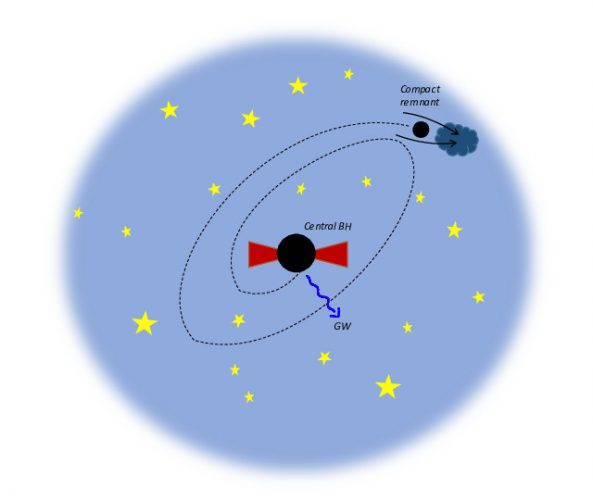
Illustration of the quick growth mechanism for supermassive black holes

An article published in “The Astrophysical Journal” reports a study on a possible quick growth mechanism of supermassive black holes that could explain their presence when the universe was very young. Ph.D. student at SISSA (International School of Advanced Studies) Lumen Boco and his supervisor Andrea Lapi created a new model based on a process already considered important called dynamical friction in the gaseous medium applying it to multiple mergers.