Black holes

Illustration of photon subrings around a black hole

An article published in the journal “Science Advances” reports a study on the possibility of obtaining sharp images of the subrings that form the photon ring around a black hole. A team of researchers led by Michael Johnson of of the Center for Astrophysics – Harvard and Smithsonian (CfA) worked on the feat announced almost a year ago with the publication of the photo of the area around the supermassive black hole at the center of the galaxy M87. The researchers think that adding a space telescope to the ones used by the Event Horizon Telescope (EHT) collaboration would allow to obtain the sharpness needed to distinguish one of the subrings, whose characteristics would allow to obtain more precise measurements of the mass of the black hole and more.

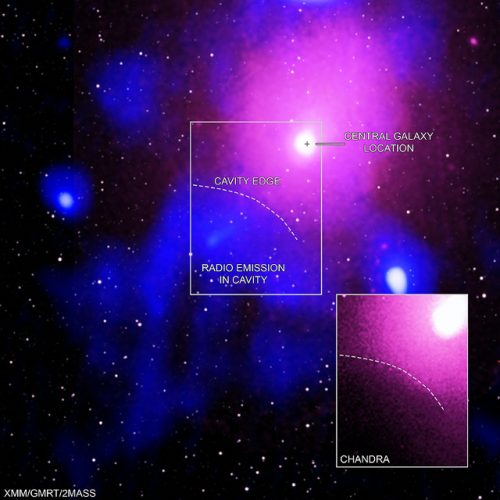
The outburst region in the Ophiuchus supercluster

An article published in “The Astrophysical Journal” reports the observation of what was called the largest explosion discovered in the universe after the Big Bang and caused by the supermassive black hole in the galaxy at the center of the Ophiuchus supercluster. A team of astronomers led by Simona Giacintucci of the Naval Research Laboratory combined X-ray observations with ESA’s XMM-Newton and NASA’s Chandra space telescopes with those at radio frequencies conducted with Murchison Widefield Array (MWA) and Giant Metrewave Radio Telescope (GMRT) radio telescopes to map the cavity generated by that cataclysmic event, about 15 times the Milky Way’s size.

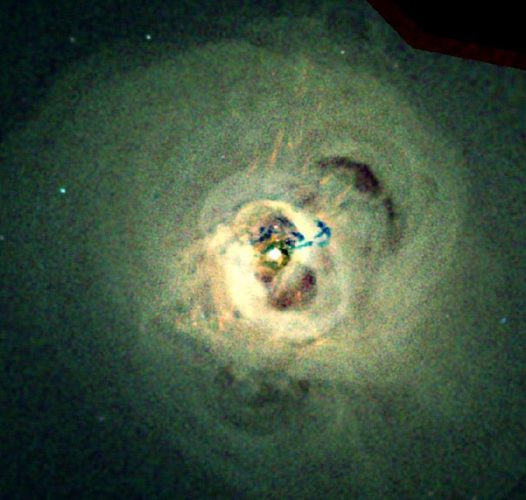
The center of the Perseus galaxy cluster (Image courtesy NASA/CXC/IoA/A.Fabian et al.)

An article published in the journal “Monthly Notices of the Royal Astronomical Society” reports the results of the study of molecular gas outflows in twelve massive galaxies at the center of galaxy clusters. A team of researchers analyzed data collected with the ALMA radio telescope to conduct this study finding that the active galactic nuclei (AGNs) of the observed galaxies cause periodic energy outbursts in the form of radiation or as jets of particles that move at speeds close to the speed of light. The energy releases cause gas outflows which can be pushed even beyond the galaxy borders. This mechanism limits the approach of the gas to the central supermassive black hole, decreasing the outbursts in what’s called a feedback. The researchers are especially studying the consequences on star formation and the possibility that a galaxy might become quenching.

Six so-called bloated stars confirmed at the center of the Milky Way

An article published in the journal “Nature” reports the identification of what were called G-objects that orbit the supermassive black hole at the center of the Milky Way, Sagittarius A* or simply Sgr A*. A team of researchers led by Anna Ciurlo of UCLA already announced the discovery of three new G-objects, now they confirm their existence and announce the identification of a fourth one. They add to the two G-objects already confirmed a few years ago. New indications could confirm the hypothesis that they’re the result of mergers of binary systems’ stars.

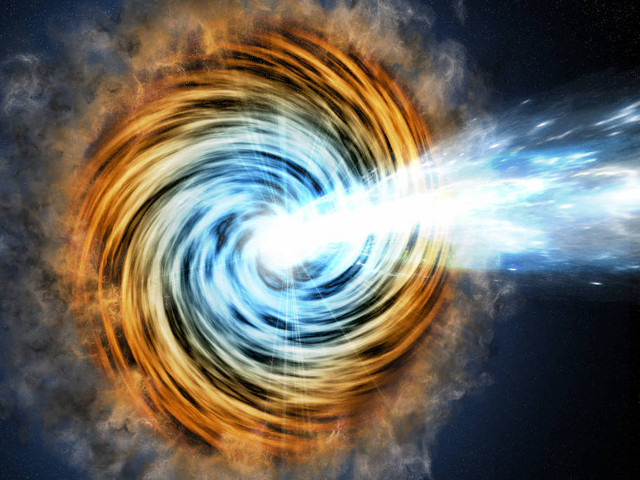
Artist's concept of a blazar (Image courtesy M. Weiss/CfA)

An article published in the journal “Monthly Notices of the Royal Astronomical Society” reports a study on the blazar CTA 102. A team of researchers used data that cross the electromagnetic spectrum from radio waves to gamma rays detected by a series of space and ground-based telescopes. They allowed to monitor the variability of CTA 102 between 2013 and 2017 and events such as the significant activity of gamma ray emissions between November 2016 and February 2017, with outbursts on four occasions with a peak reached on December 28, 2016.