
Black holes

A whole galaxy cluster influenced by the activity of a supermassive black hole

An article published in “The Astrophysical Journal” reports a study on a supermassive black hole in the galaxy cluster SPT-CLJ0528-5300 or simply SPT-0528 that had a really extraordinary outburst. A team of researchers used in particular NASA’s Chandra X-ray Observatory to study that activity finding that the materials pushed away created two huge cavities 180° from each other. By measuring the volume and pressure of the displaced gas and calculating the age of the cavities, it was possible to estimate the energy of that activity in over 1054 joules, the highest discovered so far in a distant cluster. It could be the cause of a limited star formation in clusters like this one.

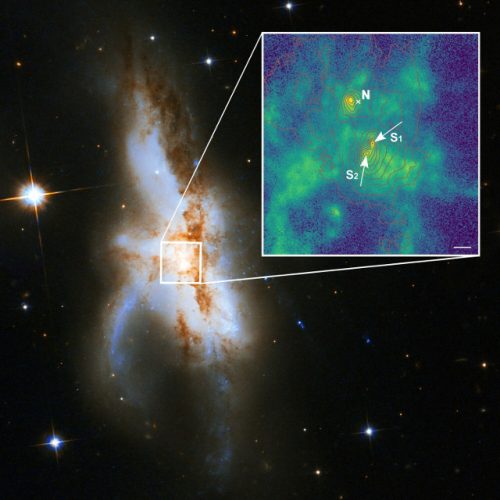
The galaxy NGC 6240 contains three supermassive black holes

An article published in the journal “Astronomy & Astrophysics” reports a study on the galaxy NGC 6240 with evidence that it contains three supermassive black holes. A team of researchers led by Professor Wolfram Kollatschny of the University of Göttingen used the MUSE instrument mounted on ESO’s VLT in Chile together with data from previous studies to obtain the high-precision observations needed to verify that within NGC 6240 there were not two supermassive black holes as it seemed from previous studies but three. This indicates that the current merger is involving three galaxies.

A study of 20 radio galaxies offers new information on the activity of the supermassive black holes at their center

An article published in the journal “Astronomy & Astrophysics” reports a study on the properties of the ionized gas that surrounds supermassive black holes in 20 galaxies selected as a sample. A team of researchers led by Barbara Balmaverde of the Italian National Institute of Astrophysics, Turin, used the MUSE spectrograph mounted on ESO’s VLT in Chile to carry out the MURALES (MUse RAdio Loud Emission line Snapshot) survey, which includes the 20 galaxies studied. These are powerful sources of radio emissions thanks to their active galactic nuclei. The mapping of the ionized gas and its interaction with the relativistic jet produced by central black holes helps to understand the mechanisms of growth and interaction with their host galaxies.

A possible low-mass black hole discovered

An article published in the journal “Science” reports the discovery of what could be the lowest-mass known black hole, perhaps even the first of a new class of black holes. A team of researchers led by Professor Todd Thompson of Ohio State University used data from APOGEE (Apache Point Observatory Galactic Evolution Experiment) to discover a binary system that includes an invisible object that could be a black hole. If instead it were a neutron star it would be by far the most massive known, far beyond the theoretical highest limit before the collapse of such an object into a black hole.

Artist's concept of MAXI J1820+070's system (Image courtesy John Paice)

An article published in the journal “Monthly Notices of the Royal Astronomical Society” reports a study of the black hole MAXI J1820+070, part of an X-ray binary system that includes a normal star to which the black hole steals gas. A team of astronomers coordinated by the British University of Southampton used the HiPERCAM and NICER instruments to detect visible light and X-rays respectively emitted during an outburst activity in 2018. The data collected were used to create a video slowed down ten times to allow astronomers to see the fastest flares and examine the details of that activity.