Black holes

Ancient quasars spin at relativistic speeds

An article published in “The Astrophysical Journal” reports an observation of 5 quasars between 9.8 and 10.9 billion light years away from Earth with the help of gravitational lenses that offered multiple images of them. A team of astronomers used NASA’s Chandra X-ray Observatory to study the accretion disks around the supermassive black holes that power those quasars, discovering that one of them spins at a speed higher than 70% of the speed of light.

The dwarf galaxy ESO 495-21 (Image ESA/Hubble, NASA)

An image captured by the Hubble space telescope shows the dwarf galaxy ESO 495-21, really small having an estimated total mass of around 10 billion solar masses, about 3% of the Milky Way. The astronomers’ interest in ESO 495-21 is due to the fact that, despite its small size, it’s of the starburst type, which means that it has a fast rate of star formation, and has at its center a supermassive black hole with a mass estimated at at least one million solar masses. It’s a case that could be similar to the first galaxies of the universe and supports the hypothesis that the dwarf galaxy formed around a black hole that already existed before.

A "cool" gas disk detected around the supermassive black hole at the center of the Milky Way

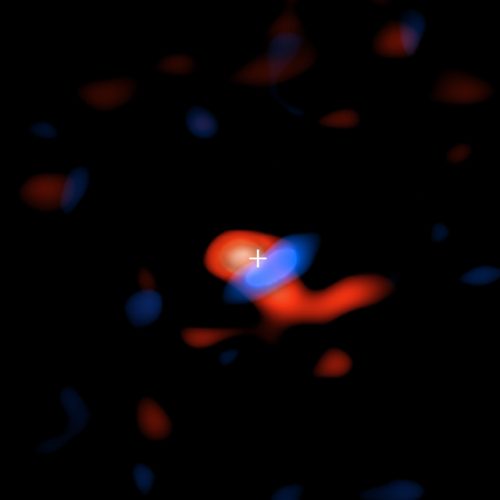
An article published in the journal “Nature” reports the detection of an interstellar gas disk around Sagittarius A*, the supermassive black hole at the center of the Milky Way. A team of researchers led by Elena Murchikova of the American University of Princeton found thanks to the ALMA radio telescope the radio emissions of the least hot component of the accretion disk that surrounds Sagittarius A*. By mapping those emissions it was possible to notice that disk’s rotation, another useful piece of data to study the processes taking place around that black hole.

The black hole V404 Cygni swings like a spinning top

An article published in the journal “Nature” reports the observation of a jet of materials emitted by the black hole V404 Cygni which changed orientation in no more than a few hours. A team led by James Miller-Jones of the Curtin University node of the International Center for Radio Astronomy Research (ICRAR), Australia, used the Very Long Baseline Array radio telescopes to study the area around the black hole during one of its periodic bursts of considerable intensity. This made it possible to observe for the first time jets of materials changing orientation in a few hours or even minutes.

The position of quasars varies over time

An article published in the journal “Monthly Notices of the Royal Astronomical Society” reports evidence that the position of quasars is not fixed. A team of astrophysicists from the Moscow Institute of Physics and Technology combined global observations of 40 quasars between 1994 and 2016 for this study. Based on the fact that the apparent positions of quasars change according to the frequency of the radiation used to observe them, the researchers wanted to verify if that effect could vary over time. Quasars are used as cosmic reference points, knowing their exact location can increase their reliability.