Black holes

The area surrounding the supermassive black hole in the Virgo A galaxy (Image EHT Collaboration)

The Event Horizon Telescope (EHT) project with representatives of ALMA and APEX radio telescope researchers held a press conference, one of many held in the world to present the first EHT results. A project that for two years engaged a series of radio telescopes from around the world to combine their observations had the aim of peering directly into the environment surrounding a black hole and in particular the supermassive black hole at the center of the Milky Way, known as Sagittarius A*, and the one at the center of the Virgo A galaxy.

83 quasars discovered in the early universe

5 articles published in the journals “The Astrophysical Journal Letters”, “The Astrophysical Journal” (here and here), “The Astrophysical Journal Supplement Series” (paiwalled, available here) and “Publications of the Astronomical Society of Japan” describe various aspects of the discovery of 83 new quasars dating back to about 13 billion years ago, studied together with 17 other quasars from that era that were already known. A team of researchers led by Yoshiki Matsuoka, now at the Japanese Ehime University, used the Hyper Suprime-Cam (HSC), an instrument mounted on the Subaru Telescope of the National Astronomical Observatory of Japan (NAOJ) in Hawaii. Those quasars are powered by supermassive black holes and their study will help perfect our cosmological models.

Surprising high-energy X-ray emissions from the Whirlpool Galaxy and its small companion

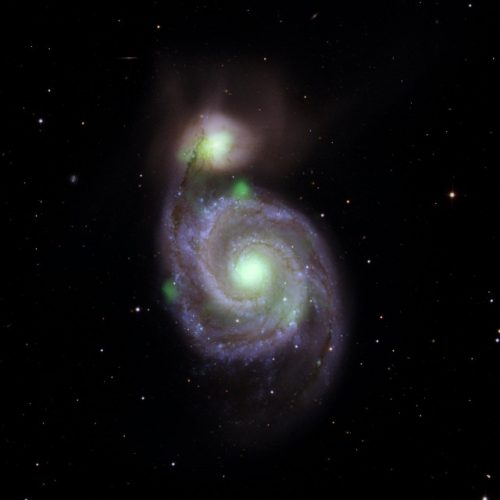
An article published in “The Astrophysical Journal” presents an in-depth spectral analysis of the two active galactic nuclei and other X-ray sources of the two galaxies that form M51. A team of researchers used NASA’s NuSTAR space telescope to detect high-energy X-ray emissions, which can pass through the layers of dust and gas that orbit the two supermassive black holes at the center of the two galaxies that are interacting in an initial phase of a galactic merger. A surprise came from the emissions of a neutron star in the Whirlpool Galaxy, the larger of the pair.

A measurement of the Hubble constant based on quasars suggests possible changes to cosmological models

An article published in the journal “Nature Astronomy” describes the use of quasars as cosmic tracers to measure the expansion of the universe up to 12 billion years ago. Guido Risaliti of the University of Florence and Elisabeta Lusso of Durham University studied the X-ray and optical emissions of a number of quasars using the comparison between those emissions to accurately assess their distances. The results could explain the discrepancies between the different measurements carried out with other methods suggesting that the density of the mysterious dark energy isn’t constant over time.

A cosmic explosion has different interpretations

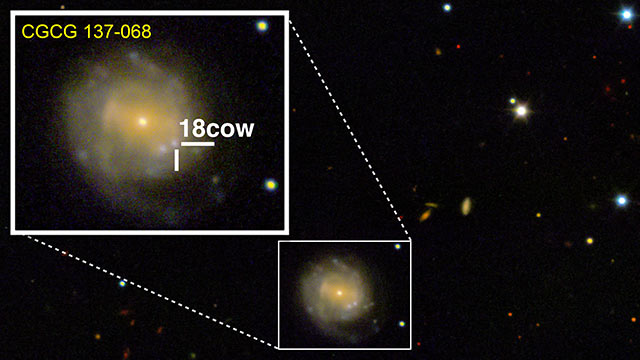
Two articles, one to be published in the journal “The Astrophysical Journal” and one in the journal “Monthly Notices of the Royal Astronomical Society”, describe studies of an anomalous event and an object cataloged as AT2018cow and therefore nicknamed “The Cow”. According to a team led by Raffaella Margutti of Northwestern University, who produced the article to be published in “The Astrophysical Journal”, it could be an anomalous supernova, tens of times brighter than normal that generated a black hole or a neutron star, while another team led by Paul Kuin of University College London (UCL), who produced the article to be published in “Monthly Notices of the Royal Astronomical Society”, it could be a black hole that destroyed a star.