Black holes

Abell 2597 seen by ALMA (yellow), MUSE (red) and Chandra (blue-purple) (Image ALMA (ESO/NAOJ/NRAO), Tremblay et al.; NRAO/AUI/NSF, B. Saxton; NASA/Chandra; ESO/VLT)

An article published in “The Astrophysical Journal” describes the observation of a sort of galactic fountain of cold molecular gas pumped by a supermassive black hole in the brightest galaxy of the galaxy cluster Abell 2597. A team of researchers used the ALMA radio telescope and the MUSE spectrograph mounted on ESO’s VLT to observe for the first time a cycle that includes both inflow and outflow that powers that fountain.

Simulation of materials near Sagittarius A* (Image ESO/Gravity Consortium/L. Calçada)

An article published in the journal “Astronomy & Astrophysics” describes the detection of very hot gas clouds that orbit the supermassive black hole at the center of the Milky Way, called Sagittarius A* or simply SgrA*. A team of researchers used the GRAVITY instrument installed on ESO’s VLT to observe infrared light flares coming from the gas and dust accretion disk that orbits SgrA* at very high speed. These are the most accurate observations of materials so close to a black hole’s event horizon.

A tail for a group of galaxies attracted by the Abell 2142 cluster

An article published in the journal “Astronomy & Astrophysics” describes the observation of a small group of galaxies attracted by the galaxy cluster Abell 2142 and approaching it a trail of very hot gas was created. A team of researchers led by Dominique Eckert, now at the German Max Planck Institute for Extraterrestrial Physics, used NASA’s Chandra X-ray space observatory to detect the emissions from a sort of tail that extends over a million light years.

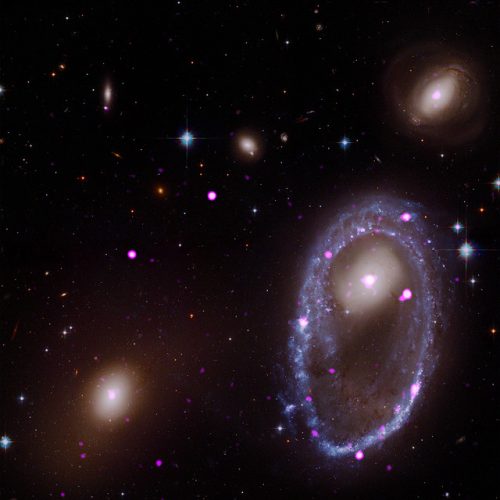
A ring galaxy with a lot of ultraluminous X-ray sources

An article published in the “Astrophysical Journal” describes the detection of a series of X-ray sources in the ring of the galaxy AM 0644-741. A team of researchers led by Anna Wolter from INAF-Osservatorio Astronomico di Brera, Italy, used observations from NASA’s Chandra X-ray Observatory to discover those ultraluminous sources concluding that the ring containing them consists of binary systems that include black holes or neutron stars and that the ring formed following a collision between galaxies.

A Hot DOG galaxy seen at X-rays

An article to be published in the journal “Astronomy & Astrophysics” describes the first detailed X-ray observation of a galaxy cataloged as W1835+4355 of a rare type because at its center there’s a quasar of the Hot DOG (Hot Dust-Obscured Galaxies) type. A team led by Luca Zappacosta of INAF in Rome, Italy, used data collected by ESA’s XMM-Newton and NASA’s NuSTAR space telescopes to obtain the most accurate X-ray emission detections from a Hot DOG galaxy. This will be useful to better understand the nature of this type of galaxies and the activity of the supermassive black hole at their center.