Black holes

Artist's illustration of the Cygnus X-1 system (Image NASA/ESA Hubble)

An article published in the journal “Nature Astronomy” describes unprecedented observations of matter around a black hole. A team of researchers used the data detected using an X-ray polarimeter on board the PoGO+ satellite to obtain information on the part of hard X-rays that are reflected from the accretion disk around the black hole of the Cygnus X-1 system and identify the shape of the matter that composes it.

GRB 161219B and its echo

An article published in the journal “Astrophysical Journal” describes the study of a sort of echo generated by a gamma-ray burst cataloged as GRB 161219B emitted by a newborn black hole. The gamma-ray emissions lasted only seven seconds but emissions at other electromagnetic frequencies lasted even for weeks, which enabled a team of astronomers to use the ALMA radio telescope to study the ones at millimeter wavelengths. They offered other information on the gamma-ray burst and on the characteristics of its powerful jets.

Artist's impression of Sagittarius A* and S2

An article published in the journal “Astronomy & Astrophysics” describes a verification of a phenomenon predicted by Albert Einstein’s general theory of relativity. Scientists from the GRAVITY collaboration used observations conducted with ESO’s Very Large Telescope (VLT) in Chile to observe the effects of the motion of a star called S2 as it passes through the extreme gravitational field near the supermassive black hole at the center of the Milky Way.

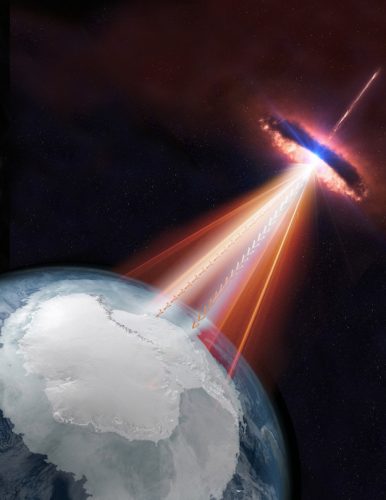
Artist's concept of a blazar emitting neutrinos and gamma rays (Image courtesy IceCube/NASA)

Various articles published in different journals shows various aspects of a research that allowed to associate a neutrino detected by the IceCube instrument at the South Pole to the blazar known as TXS 0506+056. In an article published in February 2018 in “The Astrophysical Journal Letters” a team led by Simona Paiano of the INAF of Padua showed that connection. In two articles just published in the journal “Science”, groups of scientists from 18 different observatories describe what was defined multimessenger observations of neutrino and electromagnetic emissions and a second analysis showing that other neutrinos detected by IceCube came from the same source.

MRK 1216

An article to be published in the journal “Monthly Notices of the Royal Astronomical Society” describes a research on isolated galaxies with a mass similar to the first elliptical galaxies but much smaller in which the central supermassive black hole inhibited stellar formation and grew more than normal. A team of researchers used data collected by NASA’s Chandra X-ray Observatory to examine the galaxies MRK 1216 and PGC 032873, nicknamed red nuggets, relics of the first massive galaxies that formed in the first billion years after the Big Bang.