Black holes

GW170817 seen by XMM-Newton (Image ESA/XMM-Newton; P. D'Avanzo (INAF–Osservatorio Astronomico di Brera))

Two articles, one published in the journal “Astronomy and Astrophysics” and one in “The Astrophysical Journal Letter”, describe two researches on the consequences of the merger of two neutron stars detected last year at electromagnetic and gravitational waves. ESA’s XMM-Newton space telescope was used to monitor the evolution of its X-ray emissions. NASA’s Chandra X-ray observatory was similarly used and a team of researchers concluded that the merger generated a black hole.

The center of the galaxy NGC 5643 (Image ESO/A. Alonso-Herrero et al.; ALMA (ESO/NAOJ/NRAO))

An image published by ESO and ALMA collaboration shows the center of the galaxy NGC 5643 obtained by combining observations made with the ALMA radio telescope with archive data of the MUSE instrument, mounted on ESO’s VLT. In this way it was possible to see beyond the clouds of dust and gas that obscure it even though it’s an active galactic nucleus with strong electromagnetic emissions generated by the activity of the supermassive black hole at the center of NGC 5643.

Example of quasar (Image ESA/Hubble & NASA)

An article published in the journal “Publications of the Astronomical Society of Australia” describes the discovery of the fastest growing supermassive black hole. A team of astronomers from the Australian National University (ANU) used data collected by ESA’s Gaia space probe, NASA’s WISE space telescope and the SkyMapper telescope at the ANU Siding Spring Observatory to find it. It’s a quasar, one of the brightest objects in the universe but is more than 12 billion light years away from Earth. It swallows the equivalent of the Sun’s mass every two days.

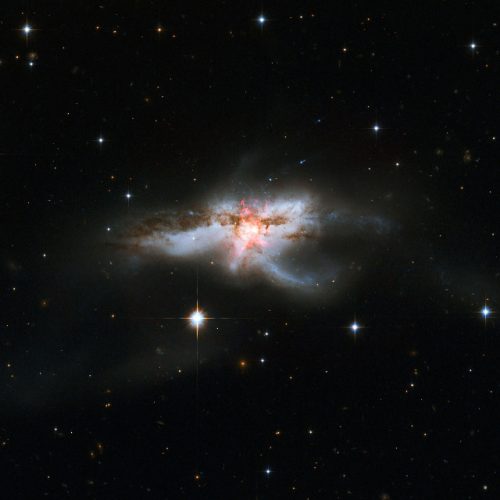
The galaxy NGC 6240 (Image NASA, ESA, the Hubble Heritage (STScI/AURA)-ESA/Hubble Collaboration, and A. Evans (University of Virginia, Charlottesville/NRAO/Stony Brook University))

An article published in the journal “Nature” describes a research on the formations similar to the wings of a butterfly in the galaxy NGC 6240. A team of researchers at the University of Colorado Boulder combined observations made with the Hubble Space Telescope, the VLT in Chile and the Apache Point Observatory in New Mexico to study that galaxy by concluding that those particular formations are generated by different forces, in one case by a pair of supermassive black holes.

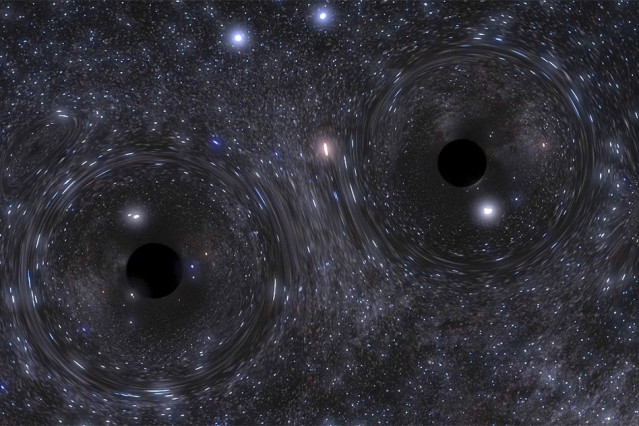
A snapshot of a simulation showing a binary black hole (Image courtesy Northwestern Visualization/Carl Rodriguez. All rights reserved)

An article published in the journal “Physical Review Letters” describes the simulations of the evolution of globular clusters of the type commonly found in galaxies to assess the possibility of black holes mergers. A team led by MIT astrophysicist Carl Rodriguez used the Quest supercomputer at Northwestern University to simulate 24 clusters with different characteristics, also calculating relativistic effects, concluding that repeated mergers can occur, forming black holes more massive than the stellar ones.