Cosmology

Eros Vanzella indicates the Lyman-Alpha emission region measured with the MUSE instrument (Photo courtesy Eros Vanzella / INAF. All rights reserved)

An article published in the journal “Monthly Notices of the Royal Astronomical Society” reports the discovery of primordial stars that could belong to the so-called Population III, the first generation of stars in the universe. A team of astrophysicists led by Eros Vanzella and Massimo Meneghetti of the Italian National Institute of Astrophysics, Bologna, used data collected with the MUSE instrument mounted on ESO’s VLT and a powerful gravitational lens generated by the galaxy cluster MACS J0416.1-2403, or simply MACS J0416, to obtain magnified images of stars that seem free of metals and composed only of hydrogen, helium and traces of lithium.

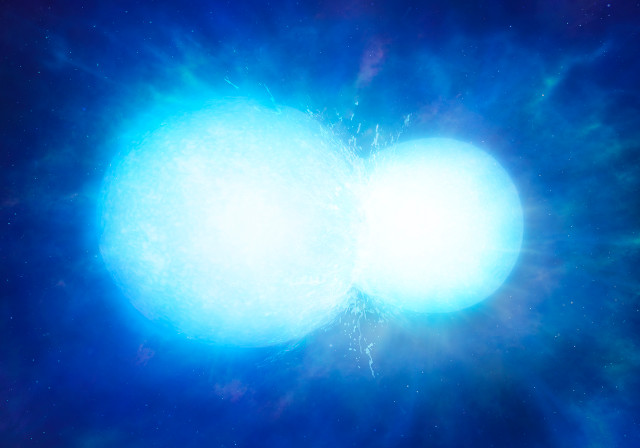
Artist's concept of colliding white dwarfs (Image courtesy University of Warwick/Mark Garlick)

An article published in the journal “Nature Astronomy” reports a study on a white dwarf out of the ordinary cataloged as WD J055134.612+413531.09, or simply WD J0551+4135. A team of astronomers coordinated by the British University of Warwick examined this white dwarf’s characteristics using data collected by ESA’s Gaia space probe and the William Herschel Telescope concluding that its atmosphere’s particular chemical composition indicates that it’s the result the merger of two medium-mass white dwarfs. WD J0551+4135 has a mass slightly higher than that of the Sun, remarkable for that type of object to the point that it was called an ultra-massive white dwarf. If it had a slightly larger mass it would probably have exploded in a supernova following the merger.

A portion of the Subaru/XMM-Newton Deep Field with a dying galaxy in the middle (Image courtesy NAOJ/M. Tanaka)

Two articles, one published in “The Astrophysical Journal Letters” and one in “The Astrophysical Journal”, report the results of studies on ancient quenching galaxies, which means that they strongly reduced or even finished their star-formation activity. Two teams of researchers with many of them in common used data collected with various telescopes to study these galaxies and establish that we see the oldest as it was about 1.5 billion years after the Big Bang. These studies offer new information to improve galaxy formation models.

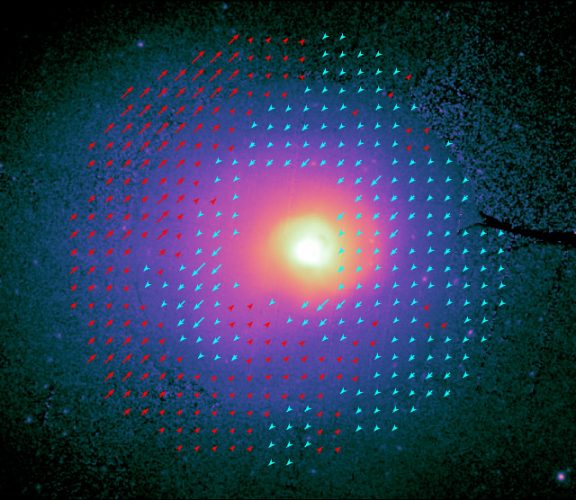
A map of plasma motions in the Perseus and Coma galaxy clusters

An article published in the journal “Astronomy & Astrophyiscs” reports the mapping of the distribution and motion of hot gas within the Perseus and Coma galaxy clusters. A team of researchers led by Jeremy Sanders of the Max Planck Institute for extraterrestrial physics in Garching, Germany, used in particular ESA’s XMM-Newton space telescope to study those two large clusters and detect the gas that, at very high temperatures and in the form of a plasma, shines at X-rays. This mapping offers new information on the formation and evolution of galaxy clusters.

The afterglow of GRB 190114C observed by Hubble (Image NASA, ESA, and V. Acciari et al. 2019)

Three articles published in the journal “Nature” report different aspects of the study of a gamma-ray burst cataloged as GRB 190114C which was observed at many frequencies in what’s called multiband observation. Many scientists, particularly the ones from the MAGIC Collaboration, combined observations made using space and ground-based telescopes to study the gamma-ray burst with the greatest energy ever observed. In fact, photons were detected with an energy of the order of the teraelectronvolt, a level theorized for a long time but only now confirmed. A fourth article to be published in the journal “Astronomy and Astrophysics” reports an analysis of the galaxy in which GRB 190114C occurred.