Cosmology

The image of an ancient galaxy multiplied by a gravitational lens

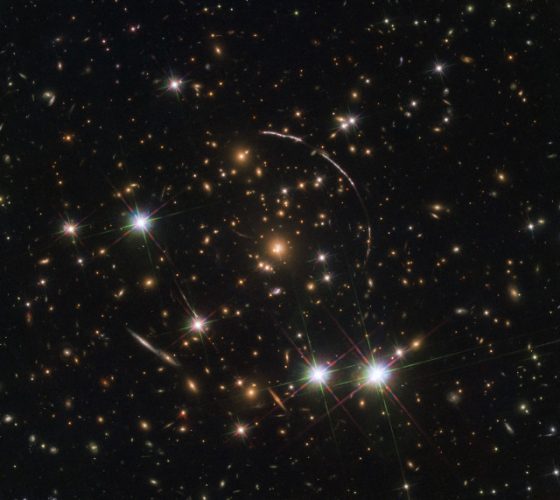
An article published in the journal “Science” reports a study of a galaxy nicknamed Sunburst Arc observed through a gravitational lensing effect that leads to multiplying its image obtaining at least 12 distorted copies in four large arcs. The Hubble Space Telescope detected the light from that galaxy, about 11 billion light years from Earth, thanks to that effect, which also made it between 10 and 30 times brighter. Studying such an ancient galaxy allows to gather information on the early universe and on what’s called the epoch of reionization.

Filaments (in blue) that connect the galaxies (in white) of the SSA22 cluster (Image courtesy Hideki Umehata)

An article published in the journal “Science” reports the discovery of massive gas filaments between the galaxies of a protocluster cataloged as SSA22 about 12 billion light years from Earth. A team of researchers coordinated by the RIKEN Cluster for Pioneering Research used the MUSE spectrograph mounted on the VLT in Chile and the Suprime-Cam on the Subaru telescope to map those filaments, which extend over more than 3 million light years. Follow-up observations that provided further details were conducted with the ALMA radio telescope and the Keck telescope. The filament gas can feed star formation and the growth of supermassive black holes in the protocluster. The observation of those processes can provide new information on the evolution of galaxies.

The afterglow of the event GW170817 in the inset (Image courtesy Wen-fai Fong/Northwestern University)

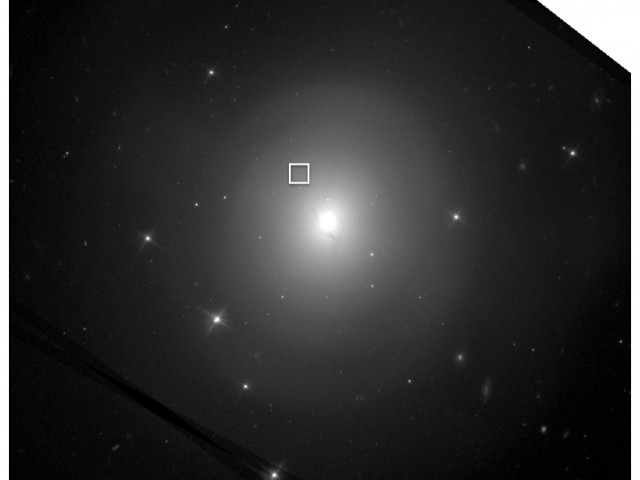
An article accepted for publication in “The Astrophysical Journal Letters” reports the results of the search for the afterglow of the merger between two neutron stars identified two years ago and cataloged as GW170817. It made history because it’s the first event of that type identified and was observed at both gravitational waves and electromagnetic waves. A team of researchers led by Wen-fai Fong of Northwestern University used the Hubble space telescope to detect the now very dim afterglow, the residual radiation after months of strong emissions.

A gamma-ray burst from 2016 might have originated from a neutron star merger

An article published in the journal “Monthly Notices of the Royal Astronomical Society” reports a study on the short-duration gamma-ray burst cataloged as GRB160821B that has characteristics that match those of the merger of neutron stars observed at both electromagnetic waves and gravitational waves on August 17, 2017. A team of researchers led by Eleonora Troja of the University of Maryland used data collected from various telescopes to compare the two events and the 2016 one was observed since its early hours providing new information on the initial phase of what’s called a kilonova.

SN 2016iet is probably a pair-instability supernova

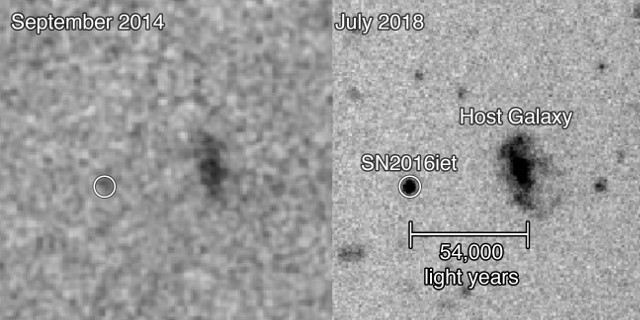
An article published in “The Astrophysical Journal” reports a study on the supernova SN 2016iet. A team of researchers used a number of telescopes to collect data on it. Almost three years of study have followed its first sighting, which happened on November 14, 2016, leading to estimate that the progenitor star had a mass about 200 times the Sun’s which exploded in what appears to be the first strong case of pair-instability supernova, which ends with the star’s total destruction.