Cosmology

An article submitted for publication in the “Astrophysical Journal Letters” reports the discovery of eight repeating Fast Radio Bursts (FRBs). The CHIME/FRB collaboration, the team of scientists who use the CHIME radio telescope to search for these phenomena, gathered evidence of these new Fast Radio Bursts after the announcement of the second repeating one’s discovery months ago. This suggests that these phenomena are not so rare compared to non-repeating ones but that we have only recently found a way to detect them.

39 ancestors of massive elliptical galaxies discovered in the early universe

An article published in the journal “Nature” reports the discovery of 39 galaxies in the early universe. A team of researchers combined data from different telescopes to identify a group of galaxies dating back to the first two billion years after the Big Bang that were invisible to previous observations in their areas conducted at optical frequencies. Their study could offer new information on the evolution of galaxies, on the supermassive black holes at their center and also on the distribution of dark matter.

Representation of the jet of a gamma-ray burst such as GRB 190114C (Image courtesy Kitty Yeung)

An article published in “The Astrophysical Journal Letters” reports a study on a gamma-ray burst cataloged as GRB 190114C and detected by NASA’s Swift satellite and the MAGIC telescopes at the Canaries. Professor Evgeny Derishev and Professor Tsvi Piran put together the data from these detecions, which are about photons at very different energies, concluding that the radiations detected must have originated in a jet that moved at a speed of about 99.99% of the speed of light. These are so-called ultra-high energy emissions in the Teraelettronvolt (TeV) range and they think that the mechanism of origin is the inverse Compton scattering while emissions of less energetic photons originate from synchrotron radiation.

Using red giants to estimate the speed of the universe expansion

An article being published in “The Astrophysical Journal” reports a new attempt to calculate the speed of the universe expansion, this time using red giant stars as a reference. A team of researchers coordinated by Carnegie Institution for Science and University of Chicago and led by astronomer Wendy Freedman used observations made with the Hubble space telescope to perform that calculation. The result has a probability peak at 69.8 km/s per megaparsec, between the values ​​calculated using the two methods that provided discrepant values.

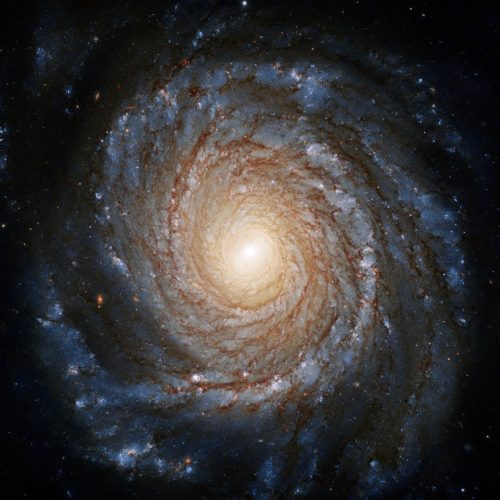
Galaxy NGC 3147 (Image ESA/Hubble & NASA, A. Riess et al.)

An article published in the journal “Monthly Notices of the Royal Astronomical Society: Letters” reports a study on a supermassive black hole surrounded by a disk of materials that revealed unexpected features. A team of researchers led by Stefano Bianchi, of the University of Roma Tre, Italy, used the Hubble Space Telescope to observe the nucleus of the galaxy NGC 3147 discovering a small and soft disk, a reduced version of the large disks typical of active galactic nuclei, a structure that shouldn’t exist. The discovery represents a new opportunity to test some relativistic effects but could force astronomers to review certain models on active galactic nuclei.