ESA

The Sentinel-6A Michael Freilich satellite blasting off atop a Falcon 9 rocket (Image NASA TV)

A short time ago, the Sentinel-6A Michael Freilich satellite was launched atop a Falcon 9 rocket from the Vandenberg base. After almost exactly an hour, it successfully separated from the rocket’s last stage and set off on its course to reach the polar orbit at 1,336 kilometers altitude where its scientific mission will begin.

This mission is a collaboration between NASA, ESA, EUMETSAT, and NOAA. For this reason, it was named Michael Freilich after the former Director of NASA’s Earth Science Division, who passed away on August 5, 2020, alongside NASA’s Jason satellites and at the same time is part of ESA’s Copernicus program.

The crater triplet in Noachis Terra (Image ESA/DLR/FU Berlin, CC BY-SA 3.0 IGO)

ESA has published photos taken by its Mars Express space probe’s High Resolution Stereo Camera (HRSC) of a crater triplet in the Noachis Terra region on planet Mars. That region gave its name to the Noachian era in which, between about 3.7 and 4.1 billion years ago, the red planet was hit by a particularly large number of meteorites, and Noachis Terra is full of craters still existing. A crater triplet with an overlap indicating three very close impacts is interesting not only as a curiosity but also for the geological history it can tell together with others from the same region.

The points of the various landings made by the lander Philae on the surface of comet 67P/Churyumov-Gerasimenko

An article published in the journal “Nature” reports a reconstruction of the trajectory of ESA’s Rosetta mission’s Philae lander in its touchdown on the surface of comet 67P/Churyumov-Gerasimenko. A team of researchers examined data collected by the Rosetta space probe and the Philae lander to find out where the latter made its second touchdown on the comet, which was followed by further bounces before finally landing. The study also showed that the affected materials contained an abundant amount of ice as soft as freshly laid snow, to the point of being described as softer than cappuccino froth.

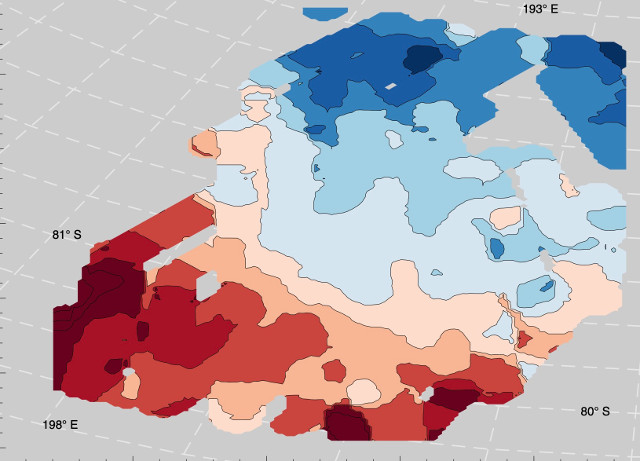
Radar map of the Mars area where the lake system was found (Image courtesy Sebastian Emanuel Lauro et al. Nature Astronomy, 2020)

An article published in the journal “Nature Astronomy” reports the discovery of new underground lakes of very salty liquid water under the planet Mars’ south pole cap. A team of researchers led by Elena Pettinelli and Sebastian Lauro, both of the Italian Roma Tre University, used data collected by ESA’s Mars Express space probe’s Mars Advanced Radar for Subsurface and Ionosphere Sounding (MARSIS) instrument to discover what form a lake system consisting of three main lakes surrounded by other smaller lakes. This confirms the discovery of a lake announced in July 2018 and offers evidence that this is not a unique case. It remains an extreme environment, so it takes some speculation to imagine life forms in those lakes, but the authors of this new research also recommend increasing the exploration of those areas to understand their potential is to host life.

Scheme of the CONSERT radar's work

An article published in the journal “Monthly Notices of the Royal Astronomical Society” reports a study indicating that the interior of the nucleus of comet 67P/Churyumov-Gerasimenko is porous and less dense than its surface. A team of researchers reviewed data collected by ESA’s Rosetta space probe and its Philae lander’s CONSERT instrument. The signals exchanged between them through the cometary nucleus propagated at different speeds, indicating a varying density of its interior. This suggests that solar radiation changed the surface, making it less porous.